Total Pageviews

Monday, October 20, 2008

Record Rally in St. Louis: 100,000!!!!!


MONDAY 20 OCTOBER 2008

Obama Says Meet Me in St. Louis - and a Record 100,000 Turn Up
Saturday 18 October 2008
by: Julian Gavaghan, The Daily Mail UK

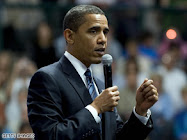
Senator Barack Obama spoke to aa enthusiastic crowd of over 100,000 people in St. Louis Missouri on Saturday. (PHOTO: Jae C. Hong / AP)

Barack Obama made history again today after drawing the highest American crowd of this year's presidential campaign.

The senator who became the first black man to become a candidate was cheered on by more than 100,000 people in St. Louis, Missouri.

"All I can say is wow," he said as he took the stage in his latest bid to woo voters in the key battleground state.

Every four years, Missouri commands attention because of its bellwether status. It has voted for every presidential winner since 1900, with the exception of 1956.

The Illinois Democrat has drawn big crowds all through his contest with John McCain, who Mr Obama now leads by up to 14 points in nationwide polls.

In May the 47-year-old attracted about 75,000 to an event in Portland, Oregon before that state's primary election.

And in the German capital, Berlin, he drew more than 200,000 during a foreign tour in July.

But today's massive crowd in his neighbouring state set a record at home for the charismatic candidate.

Mr Obama used the speech to defend his tax cut proposals, which Mr McCain, an Arizona senator, had criticised earlier in the day during a stop in North Carolina.

"John McCain is so out of touch with the struggles you are facing, he must be the first politician in history to call a tax cut for working people 'welfare.'" he told the crowd assembled in a city square.

"George Bush and John McCain are out of ideas, they are out of touch, and if you stand with me in 17 days they'll be out of time."

But despite Mr Obama's runaway national lead, the U.S. election depends on candidates winning big states.

And a CNN/Time/Opinion Research poll released earlier this week showed the two candidates in a virtual tie in Missouri, the 18th most populous state.

Today's visit was his seventh trip to there since he secured the nomination.

Mr McCain, meanwhile, is schedule to stop in the state on Monday.

The ability of Mr Obama to give attention to Missouri little more than two weeks before Election Day stands in stark contrast to John Kerry, the 2004 Democratic nominee who had virtually conceded Missouri at this point in his campaign.

As it has in other states, economic stress in Missouri has boosted Mr Obama's campaign here, as voters express strong frustration with the nation's current direction.

If he is to win the state, Mr Obama will need to boost turnout in the urban centers of St. Louis and Kansas City to counter the state's strong base of conservative evangelicals.

His campaign, however, has been aggressively registering new voters, especially in the major urban centres of St. Louis and Kansas City, where it hopes to dramatically increase voter turnout.

Even before Obama secured his party's nomination, he started making trips into the state, including one in May where he met with workers in Cape Girardeau, the boyhood home of ultra conservative talk radio host Rush Limbaugh.

"We're going to spend a lot of time in Missouri making sure we win this state," Obama said during that stop.

----

Remarks of Senator Barack Obama-as prepared for delivery
St. Louis, Missouri
Saturday 18 October 2008

We meet at a moment of great uncertainty for America. The economic crisis we face is the worst since the Great Depression. As the stock market has plummeted, millions of Americans have opened up their 401(k) statements to see that so much of their hard-earned savings have disappeared.

The credit crisis has left businesses large and small unable to get loans, which means they can't buy new equipment, or hire new workers, or even make payroll for the workers they have. In households across the country, it's getting harder and harder to get a loan for that new car or that startup-business or that college you've dreamed of attending. Wages are lower than they've been in nearly a decade. You're paying more for everything from gas to groceries, but your paychecks have flat-lined.

I know these are difficult times. I know folks are worried. But I believe that we can steer ourselves out of this crisis because I believe in this country. Because this is the United States of America. This is a nation that has faced down war and depression; great challenges and great threats. The American story has never been about things coming easy - it's been about rising to the moment when the moment is hard.

America can meet this moment. We have the most talented, most productive workers of any country on Earth. We're home to innovation and technology, colleges and universities that are the envy of the world. Some of the biggest ideas in history have come from our small businesses and research facilities. It won't be easy, but there's no reason we can't make this century another American century.

But Missouri, I also know this. It will take a new direction. It will take new leadership in Washington. It will take a real change in the policies and politics of the last eight years. And that's why I'm running for President of the United States of America.

Even as we face the most serious economic crisis of our time; even as you are worried about keeping your jobs or paying your bills or staying in your homes, my opponent's campaign announced earlier this month that they want to 'turn the page' on the discussion about our economy so they can spend the final weeks of this election attacking me instead. Senator McCain's campaign actually said, and I quote, "if we keep talking about the economy, we're going to lose."

Well, Missouri, here's what my opponent doesn't seem to understand. With the economy in turmoil and the American Dream at risk, the American people don't want to hear politicians attack each other - you want to hear about how we're going to attack the challenges facing middle class families each and every day. You want to hear about the issues that matter in your lives. You want to hear about how we're going to bring about the change that we desperately need for our country. That's what the American people want to hear.

So let's talk about the issues that matter. In the debate this week, my opponent felt the need to inform me that he's not President Bush. And in fairness, I don't blame Senator McCain for all of President Bush's mistakes. After all, he's only voted with George Bush 90 percent of the time.

But it is fair to say that over the course of three debates and twenty months, Senator McCain still hasn't offered a single thing that he would do differently from George W. Bush when it comes to the most important economic issues we face today. Not one.

Just look at taxes. My opponent's been talking a lot about taxes in his campaign. But here's the truth Missouri - we are both offering tax cuts. The difference is who we're cutting taxes for.

It comes down to values - in America, do we simply value wealth, or do we value the work that creates it? For eight years, we've seen what happens when we put the extremely wealthy and well-connected ahead of working people. Now, John McCain thinks that the way to rebuild this economy is to double down on George Bush's policy of giving more and more tax breaks to those at the very top in the false hope that it will all trickle down. I think it's time to rebuild the middle class in this country, and that is the choice in this election.

Senator McCain wants to give the average Fortune 500 CEO a $700,000 tax cut but absolutely nothing at all to over 100 million Americans. I want to cut taxes - cut taxes - for 95 percent of all workers. And under my plan, if you make less than $250,000 a year - which includes 98 percent of small business owners - you won't see your taxes increase one single dime. Not your payroll taxes, not your income taxes, not your capital gains taxes - nothing. It's time to give the middle class a break, and that's what I'll do as President of the United States.

Lately, Senator McCain has been attacking my middle class tax cut. He actually said it goes to, "those who don't pay taxes," even though it only goes to working people who are already getting taxed on their paycheck. That's right, Missouri - John McCain is so out of touch with the struggles you are facing that he must be the first politician in history to call a tax cut for working people "welfare."

The only "welfare" in this campaign is John McCain's plan to give another $200 billion in tax cuts to the wealthiest corporations in America - including $4 billion in tax breaks to big oil companies that ran up record profits under George Bush.

That's who John McCain is fighting for. But we can't afford four more years like the last eight. George Bush and John McCain are out of ideas, they are out of touch, and if you stand with me in 17 days they will be out of time.

We need new priorities in Washington. I think it's time to give a tax cut to the teachers and janitors who work in our schools; to the cops and firefighters who keep us safe; to the waitresses working double shifts, the nurses in the ER, and the plumbers fighting for their American Dream. These workers are the backbone of our country. They are the ones that Washington has forgotten. They're the ones I'll fight for. And while Senator McCain ignores the payroll taxes you pay to score a few political points, I'll put a tax cut into the pockets of working people so you can pay the bills, put away some savings, and pass on a brighter future to your children.

So Senator McCain can keep trying to attack me and distract you - but it's not going to work. Not this time - not now. Because while my opponent thinks this campaign is all about me - the truth is, this campaign is about you. Your jobs. Your health care. Your retirement. Your children's future. That's what this election is about. That's what I'm fighting for. Because I can take 2 more weeks of these attacks from John McCain, but the American people can't take four more years of the same failed policies and the same divisive politics. That's why I'm running for President of the United States.

It is time to turn the page on eight years of economic policies that put Wall Street before Main Street but ended up hurting both. We need policies that grow our economy from the bottom-up, so that every American, everywhere, has the chance to get ahead. Not just the person who owns the factory, but the men and women who work on its floor. Because if we've learned anything from this economic crisis, it's that we're all connected; we're all in this together; and we will rise or fall as one nation - as one people.

The rescue plan that passed the Congress was a necessary first step to easing this credit crisis, but now we need a rescue plan for the middle class. If we're going to rebuild this economy from the bottom up, it has to start on Main Street - not just the big banks on Wall Street. That's why I've outlined several steps that we have to take right now to help folks who are struggling.

First, we've got to act now to create good paying jobs. We've already lost three-quarters of a million jobs this year. That's why I've proposed a new American jobs tax credit for each new employee that companies hire here in the United States over the next two years. And that's why I'll stop giving tax breaks to companies that ship jobs overseas and invest in companies that create good jobs right here in Missouri.

Second, we need to help small businesses get back on their feet. To fuel the real engine of job creation in this country, I'll eliminate all capital gains taxes on investments in small businesses and start-up companies, and provide an additional tax incentive through next year to encourage new small business investment. And we'll also make sure that small businesses can access the immediate loans they need to pay their workers and finance their inventory.

Third, we need to provide relief for homeowners. The Treasury must use the authority it's been granted and move aggressively to help people avoid foreclosure and stay in their homes. We don't need a new law or a new $300 billion giveaway to banks like Senator McCain has proposed. We just need to act quickly and decisively. For those responsible homeowners in danger of losing their homes, I've proposed a three-month moratorium on foreclosures so that we give people the breathing room they need to get back on their feet.

Finally, we've got to help states and local governments that have been squeezed. Today, twenty-one states are facing budget short-falls, and they might be forced to cut services or raise taxes. That's why I'm going to create a $25 billion fund to help states and local governments pay for health care and education, police and firefighters, without having to raise your taxes. And we'll save one million jobs by creating a Jobs and Growth Fund that will help states move forward with projects to rebuild and repair our roads, our bridges, and our schools.

These are the steps that we must take - right now - to start getting our economy back on track. But we also need a new set of priorities to grow our economy and create jobs over the long-term.

If I am President, I will invest $15 billion a year in renewable sources of energy to create five million new, green jobs over the next decade - jobs that pay well and can't be outsourced; jobs building solar panels and wind turbines and fuel-efficient cars; jobs that will help us end our dependence on oil from Middle East dictators.

I'll also put two million more Americans to work rebuilding our crumbling roads, schools, and bridges - because it is time to build an American infrastructure for the 21st century. And if people ask how we're going to pay for this, you tell them that if we can spend $10 billion a month in Iraq, we can spend some money to rebuild America.

If I am President, I will finally fix our broken health care system. This issue is personal for me. My mother died of ovarian cancer at the age of 53, and I'll never forget how she spent the final months of her life lying in a hospital bed, fighting with her insurance company because they claimed that her cancer was a pre-existing condition and didn't want to pay for treatment. If I am President, I will make sure those insurance companies can never do that again.

My health care plan will make sure insurance companies can't discriminate against those who are sick and need care most. If you have health insurance, the only thing that will change under my plan is that we will lower premiums. If you don't have health insurance, you'll be able to get the same kind of health insurance that Members of Congress get for themselves. And we'll invest in preventative care and new technology to finally lower the cost of health care for families, businesses, and the entire economy. That's the change we need.

Senator McCain has been eager to share some details of his health care plan - but not all. First, we found out that he wants to pay for his plan by taxing your health care benefits for the first time in history, just like George Bush. That was bad enough. But it turns out, Senator McCain would pay for part of his plan by making drastic cuts in Medicare ñ$882 billion worth. Under his plan, if you count on Medicare, you would have fewer places to get care, and less freedom to choose your doctors. You'll pay more for your drugs, receive fewer services, and get lower quality care.

I think every single American has a right to affordable accessible health care. We can strengthen Medicare by eliminating wasteful subsidies to big HMOs in Medicare, and making sure seniors can access home-based care, and letting Medicare negotiate with drug companies for better prices. That's the kind of change we need.

And if I'm President, we'll give every child, everywhere the skills and the knowledge they need to compete with any worker, anywhere in the world. I will not allow countries to out-teach us today so they can out-compete us tomorrow. It is time to provide every American with a world-class education. That means investing in early childhood education. That means recruiting an army of new teachers, and paying them better, and giving them more support in exchange for higher standards and more accountability.

And it means making a deal with every American who has the drive and the will but not the money to go to college. My opponent's top economic advisor actually said that they have no plan to invest in college affordability because we can't have a giveaway to every special interest. Well I don't think the young people of America are a special interest - they are the future of this country. That's why I'll make this deal with you: if you commit to serving your community or your country, we will make sure you can afford your tuition. No ifs, ands or buts. You invest in America, America will invest in you, and together, we will move this country forward.

Finally, I will take on the corruption in Washington and on Wall Street to make sure a crisis like this can never, ever happen again. I'll put in place the common-sense regulations and rules of the road I've been calling for since March - rules that will keep our market free, fair, and honest; rules that will restore accountability and responsibility in our corporate boardrooms.

And just as we demand accountability on Wall Street, I will also demand it in Washington. That's why I'm not going to stand here and simply tell you what I'm going to spend, I'm going to tell you how we're going to save when I am President.

I'll do what you do in your own family budgets and make sure we're spending money wisely. I will go through the entire federal budget, page by page, line by line, and eliminate programs that don't work and aren't needed. We'll start by ending a war in Iraq that's cost us nearly a trillion dollars. And we'll save billions more by cutting waste, improving management, and strengthening oversight.

These are the changes and reforms we need. A new era of responsibility and accountability on Wall Street and in Washington. Common-sense regulations to prevent a crisis like this from ever happening again. Investments in the technology and innovation that will restore prosperity and lead to new jobs and a new economy for the 21st century. Bottom-up growth that gives every American a fair shot at the American dream. And above all confidence ñ confidence in America, confidence in our economy, and confidence in ourselves.

I won't pretend this will be easy or come without cost. We will all need to sacrifice and we will all need to pull our weight because now more than ever, we are all in this together. This country and the dream it represents are being tested in a way that we haven't seen in nearly a century. And future generations will judge ours by how we respond to this test. Will they say that this was a time when America lost its way and its purpose? When we allowed our own petty differences and broken politics to plunge this country into a dark and painful recession?

Or will they say that this was another one of those moments when America overcame? When we battled back from adversity by recognizing that common stake that we have in each other's success?

This is one of those moments. I realize you're cynical and fed up with politics. I understand that you're disappointed and even angry with your leaders. You have every right to be. But despite all of this, I ask of you what's been asked of the American people in times of trial and turmoil throughout our history. I ask you to believe - to believe in yourselves, in each other, and in the future we can build together.

Together, we cannot fail. Not now. Not when we have a crisis to solve and an economy to save. Not when there are so many Americans without jobs and without homes. Not when there are families who can't afford to see a doctor, or send their child to college, or pay their bills at the end of the month. Not when there is a generation that is counting on us to give them the same opportunities and the same chances that we had for ourselves.

We are 17 days away from changing this country. 17 days. But for those who are getting a little cocky, I've got two words for you: New Hampshire. That's where I learned - with the help of my great friend and supporter Hillary Clinton - that you can't let up or pay too much attention to the polls. We've got to keep making our case for change; we've got to keep fighting for every vote; we've got to keep running through that finish line. This election is too important to take anything for granted. The future that you and I seek for our children is too important to let up now. The time for change has come.

We can do this. Americans have done this before. Some of us had grandparents or parents who said maybe I can't go to college but my child can; maybe I can't have my own business but my child can. I may have to rent, but maybe my children will have a home they can call their own. I may not have a lot of money but maybe my child will run for Senate. I might live in a small village but maybe someday my son can be president of the United States of America.

Now it falls to us. Together, we cannot fail. And I need you to make it happen. If you want the next four years looking like the last eight, then I am not your candidate. But if you want real change - if you want an economy that rewards work, and that works for Main Street and Wall Street; if you want tax relief for the middle class and millions of new jobs; if you want health care you can afford and education that helps your kids compete; then I ask you to knock on some doors, make some calls, talk to your neighbors, and give me your vote on November 4th. And if you do, I promise you - we will win Missouri, we will win this election, and then you and I - together - will change this country and change this world. Thank you, God bless you, and may God bless America.

Record Fundraising: You Did It!!!!

Obama raises record $150 million in September
• Story Highlights
• September amount is biggest monthly fundraising total for a presidential
campaign
• The Obama campaign added 632,000 new donors in September
• McCain accepted $85 million in federal funds for last two months of campaign

DUNN, North Carolina (CNN) -- Barack Obama's campaign announced Sunday the Democratic presidential candidate raised $150 million in donations in September, setting a new high-water mark in campaign fundraising.

Barack Obama calls a prospective voter from a headquarters in Kansas City, Missouri, on Saturday.

In a campaign video, Obama campaign manager David Plouffe said a record 632,000 new donors gave to the campaign, with the average contribution under $100. More than 3 million donors have given so far.

The Obama campaign raised $65 million in August.

Regardless of the stunning haul, Plouffe told supporters the campaign still needed more money because of "the slime that we're getting from the McCain campaign."

Plouffe cited recent attack ads and automated phone calls in battleground states and said the campaign needed to have every resource to "fight back."

"Their campaign is going to descend even more into the gutter," he said.
Plouffe also said the campaign was expanding its reach to compete "aggressively" in West Virginia.

Tightening polls in Georgia and North Dakota meant more money and resources could be sent to those two states in the remaining days, he said.

"We can't afford to make any cuts. We have to execute everything we think is required to win," Plouffe said of their battleground strategy. "None of us can look back on the night of November 4 or the morning of November 5 and wished we had done something extra."

The McCain campaign accepted $85 million in federal matching funds for the last two months of the campaign.

The Obama campaign opted out of the matching funds program and is free to raise and spend as much money as it can.

Saturday, October 18, 2008

Murtha's "Racist" Pennsylvania: What the People are Saying

Is it possible that racism does not matter when it comes to Obama? Check out the response to the canvasser just below the Jack Kerouac report from "On the Road." It will put the "racism thing" in perspective. We have got the keep working to make the landslide a reality. The 50-state strategy is working and remains a possibility. It was encouraging when we saw "Republicans for Obama." Then there was "Bikers for Obama." That was even more encouraging. At the Democratic National Convention, there was reason to be ecstatic when we saw "Rednecks for Obama." Now we are talking about "Racists for Obama!" Has Obama won all of America??? RGN

On the Road: Western Pennsylvania
“I walked five miles to get out of Pittsburgh, and two rides, an apple truck and a big trailer truck, took me to Harrisburg in the soft Indian-summer rainy night. I cut right along. I wanted to get home…. That night in Harrisburg I had to sleep in the railroad station on a bench; at dawn the station masters threw me out. Isn’t it true that you start your life a sweet child believing in everything under your father’s roof?”

– Jack Kerouac, “On the Road”

So a canvasser goes to a woman's door in Washington, Pennsylvania. Knocks. Woman answers. Knocker asks who she's planning to vote for. She isn't sure, has to ask her husband who she's voting for. Husband is off in another room watching some game. Canvasser hears him yell back, "We're votin' for the n***er!"

Woman turns back to canvasser, and says brightly and matter of factly: "We're voting for the n***er."

In this economy, racism is officially a luxury. How is John McCain going to win if he can't win those voters? John Murtha's "racist" western Pennsylvania district, where this story takes place, is some of the roughest turf in the nation. But Barack Obama is on the ground and making inroads due to unusually strong organizing leadership.

In Washington County, a bellwether in this traditional swing state that John Kerry carried by a mere 552 votes out of over 96,000 cast, the Obama campaign's mood is optimistic but very cautious. The campaign has registered over 4,000 new voters in this county, and enough statewide since the primary season to push the Democratic registration edge to over 1.2 million.

Still, Barack Obama wasn't competitive in the primary, and getting volunteers, knocks and phone calls was tough over the summer. "After the primary many of the Obama supporters were tired and were enjoying their summer," according to longtime resident and Obama Neighborhood Team Leader Greg Roth, whose house was used as a staging location during the primary. "Also, it took some time for some of the Hillary supporters come around."

As the campaign shifts into GOTV (get out the vote) mode, its universe of targeted voters begins to change. "We know who our voters are," said Roth. "Now we just have to go get them to vote." Asked if the racism resistance to Obama would inhibit volunteer effort here, "We had probably 200 people last night show up to our GOTV training in Washington, and it's a complete 180 from the tough summer months."


Over in Indiana, PA and Northern Cambria, PA, volunteers fielded complaints of a massive wave of ugly robocalls both paid for by John McCain's campaign and those paid for by third parties. The third party call was interactive, and purported to be from Barack Obama himself. The call starts out reasonably, and then "Obama" asks what the listener thinks is the most important issue. Whatever the response, "Obama" then launches into a profane and crazed tirade using "n***er" and other shock language.

From what we've seen, this IS the McCain ground campaign. Robocalls count as "touches" on voters, as do direct mail pieces such as this one. As David Plouffe said in today's fundraising letter to supporters, "These tactics are all that the McCain campaign and their allies have left."

In Pittsburgh, we attended Michelle Obama speech at the Soldiers and Sailors Memorial on Pitt's campus. The crowd received her with adoration, and she didn't disappoint, delivering a 45-minute speech to an assembled group of roughly 2,000 on the personal nature of the economic crisis, education, costs of the Iraq War, and health care. She urged the audience not to get complacent, even as polls in Pennsylvania showed a widening race. Work "as if we're 20 points behind," she said.

"Barack Obama, as far as I'm concerned, was always the underdog. He is still the underdog, will be the underdog until the day he's sitting in the Oval Office. We take nothing for granted."

Strongly directed from the candidate himself, Obama's campaign organizers are taking nothing for granted, and the relentless organizing beat goes on. To accommodate the more spread out nature of the turf in west-central PA, over in the more rural upper half of Cambria County, Obama's aggressive campaign has organized its volunteers to improvise with phonebank and canvass staging locations out of apartments and offices after-hours.

"Our first night about a month ago," said volunteer Jim Sabella, "about four of us huddled around a one-bulb lamp to make calls." The apartment the volunteers used for the phonebank hadn't even had the electricity turned back on yet, and so they had to improvise. "We patched it through from the neighbors with an extension cord and just decided, we will do whatever it takes. Enough is enough, and we can't take another four years like the last eight." Now well-lit, the phone bank hosts several volunteers nearly every night of the week.

Eighteen days. Philly burbs, here we come.

For the full report and graphics see: 538.com

Politico: Racists for Obama

Racists for Obama?
By: Ben Smith
October 18, 2008 10:56 AM EST

New polling and a trickle of stories from the battleground states suggest that Sen. Barack Obama's coalition includes one unlikely group: white voters with negative views of African-Americans.

Race has become the elephant in the room of the 2008 presidential campaign, with Obama’s prospect of becoming the first black president drawing some Americans closer to him while pushing others away. At times, the contest has slipped into a familiar dynamic of allegations of racism and outraged denial — but it's also challenged some easy assumptions about race, racism and prejudice.

“What you see is it’s perfectly possible to hold a negative view of at least one aspect of African-Americans and yet simultaneously prefer Obama,” said Charles Franklin, a political scientist at the University of Wisconsin-Madison. “Racial feelings are not as cut and dried — not as black and white — as people often say.”

Franklin explored those contradictions in a large, national survey taken in mid-September, when the Illinois Democratic senator's rival, Sen. John McCain (R-Ariz.), led in many polls and the nation’s economic woes had not yet produced a deep crisis. The poll asked voters whether they agreed with the statement that “African-Americans often use race as an excuse to justify wrongdoing." About a fifth of white voters said they “strongly agreed.” Yet among those who agreed, 23 percent said they’d be supporting Obama.

“This result is reasonable if you believe that race is not as monolithic an effect as we might easily assume,” Franklin said, noting that 22 percent of those who "strongly disagreed" said they'd be supporting McCain.

Anecdotes from across the battlegrounds suggest that there’s a significant minority of prejudiced white voters who will swallow hard and vote for the black man.

“I wouldn’t want a mixed marriage for my daughter, but I’m voting for Obama,” the wife of a retired Virginia coal miner, Sharon Fleming, told the Los Angeles Times recently.

One Obama volunteer told Politico after canvassing the working-class white Philadelphia neighborhood of Fishtown recently, "I was blown away by the outright racism, but these folks are … undecided. They would call him a [racial epithet] and mention how they don't know what to do because of the economy.”

The notion that there might be “racists for Obama,” as one Democrat called them, comes against the backdrop of a country whose white voters largely accept the notion of a black president.

“The economy is trumping racism,” said Kurt Schmoke, the dean of Howard University Law School and a former Baltimore mayor. “A lot of people who we might think wouldn’t vote their pocketbook because of race — now they are.”

“If you go to a white neighborhood in the suburbs and ask them, ‘How would you feel about a large black man kicking your door in,’ they would say, ‘That doesn’t sound good to me,’” said Democratic political consultant Paul Begala. “But if you say, 'Your house is on fire, and the firefighter happens to be black,' it’s a different situation.”

“The house is on fire, and one guy seems like he’s calm and confident and in charge, and that’s the only option,” he said.

That is, in less dramatic terms, more or less the campaign’s official talking point, a version of the longtime Democratic hope that class will — or at least should — matter more than race.

“Voters are less interested in the hot button and are more interested in the cooling economy,” said Rep. Jesse Jackson Jr. (D-Ill.), an Obama ally who is as on-message as his father is off.

But other, more nuanced, questions of race are also in play.

One senior congressional Democrat mused about prejudice among his own supporters. “They’ve all got one black friend,” he said, “and they won’t stop talking about their black friend.”

“That’s Obama,” he said.

And some argue that elements of Obama’s story and persona make him specifically acceptable to voters who hold broadly negative views of African-Americans.

“Not all whites associate the generic African-American with Obama,” said Ron Walters, a longtime student of race and politics and aide to the senior Jesse Jackson’s presidential campaigns. “They give him credit for having half a Caucasian ancestry, and give him credit for his education, and give him credit for his obvious ability to take complex subjects and parse them.”

The geography of racial conflict and tolerance has been a strong overlay of the electoral map. Obama has run better than past Democrats in prosperous states with little history of tension, such as Colorado and Iowa, and worse in working-class states in the Appalachian belt. His campaign has been structured around this dynamic and may actually have overestimated the number of white Democrats in the region unwilling to vote for him because of his race. Obama had ignored West Virginia, for instance, until a spate of positive polls prompted him to start advertising there this week.

Obama has also ignored Southern states with a history of deep racial division, from Arkansas to Mississippi, in favor of those that have seen an influx of new voters from the north — Virginia, North Carolina and Florida.

Until this fall, both campaigns viewed Michigan — a heavily Democratic state, but one with a history of tension between Detroit and its white suburbs — as Obama’s Achilles’ heel. In 2006, the state was deeply divided by a referendum to ban affirmative action. The measure was opposed by most African-American voters as an assault on hard-won gains, but it won broad support among whites and passed by a double-digit margin.

But earlier this month, McCain gave up the state for lost as economic concerns appear to have trumped racial ones.

“Obama’s personality — his speech, his look — he provides [white voters] with a non-threatening way to move forward on this issue, and that’s a very positive development,” said David Waymire, who led the unsuccessful opposition to the anti-affirmative action initiative. “He is not Kwame Kilpatrick,” he said, referring to the Detroit mayor who resigned last month after pleading guilty in a sex and misconduct scandal.

For black observers of American politics in particular, Obama’s ability to win over voters who harbor negative views of African-Americans at large is a complex, but hopeful, sign.

“I didn’t think the election itself is necessarily going to transport a lot of people, but I’ve been changing my view on that a bit lately,” said Walters. “I’ve been in personal circumstances where I said to myself, ‘I wonder if this person sees me differently because a black person is about to be the president of the United States?’”
© 2008 Capitol News Company, LLC

Wednesday, October 15, 2008

See/Hear George Lakoff

Be sure to see the George Lakoff talk on the Political Mind.

William Kristal to McCain: Give it Up!!!!????

Even the Neocons are saying to McCain, throw in the towel. At least that seems to be the message of William Krystal when he tells McCain to fire his campaign staff. That’s not exactly what they are saying but they might as well. With Sarah Palin as its lifeblood, the McCain campaign is unraveling. The negativity and white nationalist character of their campaign, McCain and Palin stoked the flames of extremism in desperation. As many conservatives and Republicans realize, the McCain campaign is a bust. The wheels are coming off.

That being the case, unless something drastic happens between now and November, Barack will win big. It will be a landslide. While I am hedging my bets on a 50-state victory, that is still a possibility. Barack is leading McCain among all demographics except the white male vote and the over 70s white vote. What this means that power has shifted from the “segregationist era” whites many of whom continue to cling to their male chauvinist white nationalist upbringing to a post-Brown, post Civil Rights era America.

McCain’s campaign has been backward and inept from the start. Given the dismal record of the Bush administration, conservatives and Republicans have lost all credibility with thinking people, left, right and center. The only people supporting McCain are low-information voters, unrepentant Republicans and white nationalists. Now with the nation in a financial crisis, there is no reason to believe that the American people will waste their vote on the failed candidacy of John McCain. Many of his “supporters” will stay home.

With such lame opposition, this election should be a landslide not only for Obama but the Democratic Party and its principles. Barack’s coattails will change Washington. RGN


October 13, 2008
Op-Ed Columnist
Fire the Campaign
By WILLIAM KRISTOL
It’s time for John McCain to fire his campaign.
He has nothing to lose. His campaign is totally overmatched by Obama’s. The Obama team is well organized, flush with resources, and the candidate and the campaign are in sync. The McCain campaign, once merely problematic, is now close to being out-and-out dysfunctional. Its combination of strategic incoherence and operational incompetence has become toxic. If the race continues over the next three weeks to be a conventional one, McCain is doomed.
He may be anyway. Bush is unpopular. The media is hostile. The financial meltdown has made things tougher. Maybe the situation is hopeless — and if it is, then nothing McCain or his campaign does matters.
But I’m not convinced by such claims of inevitability. McCain isn’t Bush. The media isn’t all-powerful. And the economic crisis still presents an opportunity to show leadership.
The 2008 campaign is now about something very big — both our future prosperity and our national security. Yet the McCain campaign has become smaller.
What McCain needs to do is junk the whole thing and start over. Shut down the rapid responses, end the frantic e-mails, bench the spinning surrogates, stop putting up new TV and Internet ads every minute. In fact, pull all the ads — they’re doing no good anyway. Use that money for televised town halls and half-hour addresses in prime time.
And let McCain go back to what he’s been good at in the past — running as a cheerful, open and accessible candidate. Palin should follow suit. The two of them are attractive and competent politicians. They’re happy warriors and good campaigners. Set them free.
Provide total media accessibility on their campaign planes and buses. Kick most of the aides off and send them out to swing states to work for the state coordinators on getting voters to the polls. Keep just a minimal staff to help organize the press conferences McCain and Palin should have at every stop and the TV interviews they should do at every location. Do town halls, do the Sunday TV shows, do talk radio — and invite Obama and Biden to join them in some of these venues, on the ground that more joint appearances might restore civility and substance to the contest.
The hope for McCain and Palin is that they still have pretty good favorable ratings from the voters. The American people have by no means turned decisively against them.
The bad news, of course, is that right now Obama’s approval/disapproval rating is better than McCain’s. Indeed, Obama’s is a bit higher than it was a month ago. That suggests the failure of the McCain campaign’s attacks on Obama.
So drop them.
Not because they’re illegitimate. I think many of them are reasonable. Obama’s relationship to the Rev. Jeremiah Wright is, I believe, a legitimate issue. But McCain ruled it out of bounds, and he’s sticking to that. And for whatever reason — the public mood, campaign ineptness, McCain’s alternation between hesitancy and harshness, which reflects the fact that he’s uncomfortable in the attack role — the other attacks on Obama just aren’t working. There’s no reason to think they’re suddenly going to.
There are still enough doubts about Obama to allow McCain to win. But McCain needs to make his case, and do so as a serious but cheerful candidate for times that need a serious but upbeat leader.
McCain should stop unveiling gimmicky proposals every couple of days that pretend to deal with the financial crisis. He should tell the truth — we’re in uncharted waters, no one is certain what to do, and no one knows what the situation will be on Jan. 20, 2009. But what we do know is that we could use someone as president who’s shown in his career the kind of sound judgment and strong leadership we’ll need to make it through the crisis.
McCain can make the substantive case for his broadly centrist conservatism. He can explain that our enemies won’t take a vacation because the markets are down, and that it’s not unimportant that he’s ready to be commander in chief. He can remind voters that even in a recession, the president appoints federal judges — and that his judges won’t legislate from the bench.
And he can point out that there’s going to be a Democratic Congress. He can suggest that surely we’d prefer a president who would check that Congress where necessary and work with it where possible, instead of having an inexperienced Democratic president joined at the hip with an all-too-experienced Democratic Congress, leading us, unfettered and unchecked, back to 1970s-style liberalism.
At Wednesday night’s debate at Hofstra, McCain might want to volunteer a mild mea culpa about the extent to which the presidential race has degenerated into a shouting match. And then he can pledge to the voters that the last three weeks will feature a contest worthy of this moment in our history.
He’d enjoy it. And he might even win it.

Tuesday, October 14, 2008

From the Nation: Conservatives as Crack Pots

The Conservative Crack-Up (And Crackpots)

posted by Ari Berman on 10/13/2008 @ 12:21pm

With the Republican Party experiencing a full-blown implosion, conservatives are grasping at straws in a desperate effort to bring down Barack Obama.

The latest fashionable right-wing conspiracy theory: Obama didn't write his memoir, Dreams from My Father, Bill Ayers did!

You can't make this stuff up--or, if you're a writer for the fringe website the American Thinker (a major promulgator of numerous Obama smears) I suppose you can. One of its contributors, Jack Cashill, compared Obama's memoir with Ayers' Fugitive Days and concluded that only the former Weatherman could've authored Obama's book (even though, for starters, Obama got the contract for his book in 1990 and didn't meet Ayers until 1995, the year his memoir came out).

Normally I'd just ignore such bogus drivel, except that Cashill's smear was picked up by Andy McCarthy of National Review, which still enjoys (perhaps unfairly) a modicum of respectability.

"Did Obama Write Dreams from My Father ... Or Did Ayers?" asked McCarthy on Saturday. "I don't want to feed into what sounds, at first blush, like Vince Fosteresque paranoia," McCarthy writes, and then goes on to do just that. (In case you've forgotten, some conservatives accused Bill Clinton of murdering his longtime friend, Vince Foster, in 1993.)

McCarthy's rant was too much for fellow National Review contributor Jonathan Adler, the director of the Center for Business Law and Regulation at Case Western University, to handle. Wrote Adler:

C'mon Andy. Giving credence to Jack Cashill's maybe-Ayers-wrote-Obama's-book theory is a bit much. This is even more outlandish than his stuff alleging a possible connection between Enron and Ron Brown's death. Even if Obama's book was ghost-written---and I've seen no evidence that it was--fingering Ayers as the potential author is nutter-territory stuff.

Thus gave rise to a civil war at National Review's group blog, the Corner, over whether or not Obama wrote his own memoir. Responded McCarthy:
I resisted reading Cashill's analysis for a long time---and he's not the first to advance the idea that Obama did not write his book---because I didn't want to be accused of wading into what could be taken as nutter stuff. I was then persuaded that I should at least look at it with an open mind. I'm convinced it raises major questions. I tried to treat them in a serious way. I expected to get gruff, but I did hope it wouldn't come from my own (diminishing) ranks. But such is the way it is these days.

Yes, these days conservatives can call out other conservatives as lunatics. Get used to it, Andy. Responded Adler in round II:

It's still a giant leap to Cashill's suggestion that Ayers was the actual writer of Obama's book, his "analysis" notwithstanding. There are more serious issues at stake, and we can do better than that.

But can they? While the economy tanks and America plunges into recession, there's nothing but Ayers, Ayers, Ayers over at the Corner. Not so long ago, conservatives liked to brag about how they belonged to the "party of ideas." When those ideas run dry--or are actually implemented to disastrous effect (see Bush, George W.), conspiracy-mongering is all they have left.

Stanley Fish on the Classroom and Buttons and Bows

October 12, 2008, 9:30 pm
Buttons and Bows
By Stanley Fish

Campaign buttons are a staple of any political season, but this year they are also central to yet another dispute about the rights of classroom teachers. The dispute has both a K-12 and a college version. In New York City, Department of Education Chancellor Joel Klein announced that his administration would enforce a longstanding policy prohibiting teachers from wearing campaign buttons when they are at work. In Illinois, the state university ethics office stated in its newsletter that faculty are barred not only from wearing campaign buttons in the classroom, but also from placing political bumper stickers on their cars and attending political rallies on campus.

Reaction was swift and predictable. In a letter to Chancellor Klein, United Federation of Teachers President Randi Weingarten noted that teachers have always “been allowed to express their opinions as citizens, political and otherwise, on their lapels.” American Association of University Professors President Cary Nelson (an emeritus professor at the University of Illinois, Urbana) issued a statement deploring the “chilling effect on speech” of such rules, which, he says, amount to “interference with the educational process.” He asks why “students can exercise their constitutional rights and attend rallies and wear buttons advocating candidates, but faculty cannot?”

There’s a lot to sort out here, and we might begin by separating the real issues from the silly ones.

It is silly (and unconstitutional) to dictate what faculty members can put on their cars, especially at a state university like Illinois where the parking lots are the size of Rhode Island and the odds of a student knowing which car belongs to which professor are next to nothing. At a more intimate liberal arts college, students might be aware of what cars their teachers drive, but it is unreasonable to require that students be shielded from any knowledge of professors’ political views, unless you want to say that faculty members can’t write letters to the editor because students might read them, and no one wants to say that.

The ban against attending political rallies is a closer call. On a campus with a small number of students and faculty, all of whom interact daily in a limited number of courses, there might be a worry that going directly from a rally into a classroom would run the risk of blurring the line between pedagogy and politics.

But again the risk seems too attenuated to justify a policy designed to minimize it. Joseph White, president of the University of Illinois, seems to agree, for on Oct. 6 he clarified (or, rather, backed down from) the ethics office’s memo and announced that university employees may “attend political rallies, provided that the employees are not on duty” and may also “display partisan bumper stickers on their vehicles.” (I would ban bumper stickers on aesthetic grounds, but that’s besides today’s point.)

That leaves the campaign buttons. On that matter, which is the real deal, White says that university employers may wear them so long they are not “on duty nor in the workplace.”

While there might be an argument about what is or is not “in the workplace,” classrooms surely are. So presumably the ban on professors wearing political buttons in class stands. Some of those protesting the restriction want to assimilate it to the attempt to regulate bumper stickers. Sherman Dorn acknowledges (on his blog) that “you can’t use public property to support candidates,” but “I assume,” he says, that “faculty buy their own clothes, so they’re festooning personal property” in the same way they festoon their personally owned vehicles.

But the issue is not whether the clothes or, for that matter, the buttons, belong to the teachers; the issue is what they’re using them for; and if they’re using them as political billboards — announcing their partisan identifications from their chests — the question of the intrusion of politics in the classroom cannot be avoided.

One way of answering it is to claim, as Leo Casey does, that teachers who wear campaign buttons are performing a valuable educational purpose. Rather than harm, he says, there is “some worthwhile good in students knowing that their teachers were engaged in the primary right and responsibility of citizenship-participation in the political process.”

But you don’t have to be overtly partisan in order to proclaim the virtue of participating in the political process. You can get that message across with a button that reads “I will vote on November 4th” or “Voting sustains Democracy.” A button that says Obama or McCain says only one thing: I’m for this guy and you should be, too. It doesn’t advance democracy; it advances a party.

Randi Weingarten’s failure to see this distinction is almost comical. She begins a sentence by saying that “teachers understand they cannot proselytize their personal beliefs” and ends it by saying that “they also understand the importance of showing students the value of civic participation.” But in what way is wearing a campaign button different from proselytizing your personal beliefs? You don’t have to be taking up a collection for a candidate in order to make a pitch for him. A campaign button will do just fine, and the student who sees it day after day will wonder if it might be prudent to slant an essay in a certain direction.

And as for Cary Nelson’s point (which others also make) that if students can wear campaign buttons, why can’t teachers too, the answer is obvious: if I look out and see Heather and Kevin turning themselves into advertisements for a candidate, my behavior doesn’t alter at all; but if they look up and see me announcing where I stand, they might well alter their behavior in ways of which they are not even aware. Faculty advocacy, even if it is technically silent, distorts and pollutes the educational process.

But what about a faculty member’s rights? This is the most often voiced objection to the button ban. It curtails the constitutionally protected speech of teachers. In a letter to President White, the Foundation for Individual Rights in Higher Education (an organization with whose positions I usually agree) cites Tinker v. Des Moines (1969) and its famous statement that “It can hardly be argued that either teachers or students shed their constitutional rights to freedom of speech or expression at the school house gate.” But as it turns out, this ringing declaration is merely flag-waving, for after delivering it the court announces a test (there’s always a test) that determines whether or not an abridgment of speech rights is O.K.: Does the speech at issue “materially disrupt the work and discipline of the school?”
In this case the school district did not allege any such disruption and so the majority ruled for the students who had been disciplined for wearing black armbands in protest of the Vietnam War. But the test opens the way for schools (and colleges) to argue that a particular form of speech does constitute a disruption, and subsequent cases have veered in the direction of Justice Black’s dissenting view that students and teachers do not have the right to “use the schools at their whim as a platform for the exercise of free speech,” if only because teachers are “hired to teach” and it is no business of the schools “to broadcast political or any other views to educate and inform the public.”

Justice Harlan, also writing in dissent, added that unless the regulation was designed “to prohibit the expression of an unpopular view,” schools officials “should be accorded the widest authority in maintaining discipline and good order in their institutions.” Harlan points in the direction of a conclusion I would endorse.

Restricting the behavior of teachers and students is in most cases a matter not of constitutional rights but of workplace requirements. FIRE castigates Illinois for denying its faculty “the right to engage in simple political speech like wearing campaign buttons.”

But the university does no such thing. When faculty members are not in class, they remain free to sport their buttons (White remarks that “many parts of campus are not workplaces”), and when they leave the campus, the university has no say at all about what they do or do not wear. The university’s judgment is that political speech does not belong in the classroom, which no more denies a teacher’s constitutional rights than a hospital would deny a nurse’s rights if it disciplined her for advocating for better working conditions in the middle of an operation.

My point is made for me by William Van Alstyne, past President of the AAUP and one of the world’s leading authorities on the first amendment. In a letter to current president Nelson, Van Alstyne corrects his view that faculty “have a first amendment right” to wear campaign buttons. “I have no doubt at all,” he declares, “that a university rule disallowing faculty members from exhibiting politically-partisan buttons in the classroom is not only not forbidden by the first amendment; rather, it is a perfectly well-justified policy that would easily be sustained against a faculty member who disregards the policy.”

Right! It’s no big deal. It’s a policy matter, not a moral or philosophical matter, and as long as the policy is reasonably related to the institution’s purposes, it raises no constitutional issues at all. On Oct. 10, the United Federation of Teachers filed suit to reverse the button ban, claiming that the free speech rights of teachers had been violated. If that’s their case, they’ll lose.

Monday, October 13, 2008

Ron Walters on the Bradley Effect: Not to Worry.

My Take on the Bradley Effect

By Ron Walters

As the election has drawn nearer, there has been an inevitable debate about the way in which race will play out, even spoil the result, and in that respect the so-called “Bradley Effect” – whites saying they will vote for a black candidate to pollsters, but not doing so when they go to vote – may play a role. I have been in the camp which says that the Bradley Effect may determine the election, to the point that I doubted Michele Obama who told Larry King on his TV show recently that if there was a Bradley Effect, Barack Obama would not have won the primary election. Trying to reconcile various stains of this complex issue, the primary elections do stand as something of a refutation that is a Bradley Effect at play, but looking deeper, there are other things as well.

I think there is a unique emotional content in this election that is driving it beyond the normal cues we use to determine the outcome of elections. In fact, I have used the term “landslide” several time out of respect for what I have seen on almost every indicator to determine the result of this one. The emotional content I am suggesting consists of several factors. There is the historic possibility that Barack Obama will become the first black President of the United States, a fact that will drive his numbers up from the 87% given John Kerry into the 95% range this time. Then there is the “fed-up” vote, those who are just tired of Republicans screwing up the country and are ready for to vote for a change of course. Finally, there are the latecomers to Obama, made fearful of how the Republicans have mis-managed the economy to the point that their lives are in financial jeopardy.

So, I now feel that most certainly there will be a Bradley Effect, but that it will be overwhelmed by several factors. First, the emotional content of the campaign showed up in the primary election polling. In those states that were over 25% black such as Maryland, Alabama, South Carolina, Georgia, the polling underestimated the actual turnout of black voters. This makes me conclude that in those states under 25%, pollsters did not accurately sample the smaller black populations.

Second, the Democratic registration advantage that I have alluded to previously is large and growing, and the only question is whether this advantage will be reflected in the turnout. I suggest that the unique emotional quality of this election will propel people to the polls such that this advantage will be reflected in the turnout.

Third, the huge Democratic registration advantage is comprised of a large proportion of young voters who could set records for the manner in which they turnout in this election. They are not being picked up in the polling accurately because of the complexity of contacting them through home phones, since they are mostly cell phone users. Credible surveys (Institute of Politics, Kennedy School, Harvard, others) suggests they will turnout in big numbers, so big they could determine the result.

Fourth, black Republicans voted for George Bush by 11% in the 2004 election, but polls have indicated that they now fluctuate between only 3-5% in their support for John McCain. If 5% of that number shifts into the Democratic column, it could also help to offset any Bradley effect.

A Pew Center survey several months ago suggested that there is no more Bradley effect because the 2006 elections featured black candidates whose election results were little different from the polling results. But we have never been here before with a Black man poised to take over the White House, to be not only the “President of the Nation” but leader of a tribe that is mostly white. This almost anthropological factor gives to this election an unprecedented character and will put us into some uncharted waters when it comes to analyzing the results.

Race is present in this election to the point that every survey this year has told us that whites and blacks still see things very differently in society and that where this election is concerned, there is a strong segment of voters who will use race to vote negatively. So, I am not deluded, the Bradley Effect will be at play, but this is a very special election that is moving many people to consider things more important to them than race. This means that in an election that was more “normal” the Bradley Effect could be determinative, but my take is -- not this time.


Dr. Ron Walters is the Distinguished Leadership Scholar, Director of the African American Leadership Center and Professor of Government and Politics at the University of Maryland College Park. His latest book is: Freedom is Not Enough, Black Voters, Black Candidates and American Presidential Politics (Rowman and Littlefield.)

Sunday, October 12, 2008

Viola Liuzzo's Daughter Speaks Out on Racism in the Campaign

This piece is by the daughter of Viola Liuzzo. Viola Liuzzo was a Detroit area housewife and mother of five whose best friend was her African American housekeeper. In defense of the dignity of her friend, she went to Selma to participate in the Selma voter registration campaign. She moved to Selma and lived in the public housing across the street from Brown Chapel. Brown Chapel was the staging area for the struggle.

As an aside, the picture that is often shown of of Malcolm X and Dr. Martin Luther King, Jr. shaking hands was taken when they met in Brown Chapel during this campaign.

By the time of the Selma campaign, the SNCC workers had become very disillusioned with non-violence in the face of whites not practicing non-violence. The Klan, in complicity with Southern law enforcement, were carrying out murders with impugnity.

Also winter of 1965, there was a growing view in SNCC that Malcolm's message of black self-determination was an important one. As a consequence, it was SNCC that invited Malcolm to the Selma struggle. Within weeks of this connection Malcolm was assassinated.

While these were the dynamics within the Selma campaign, few knew of the commitment of Viola Liuzzo commitment of this mother of five to the struggle. She became a martyr of the movement when she, being a white American, was killed driving marchers back to Selma from Montgomery. The deaths of blacks, versus that of whites, were generally dismissed. For whites on the other hand, white deaths got more coverage. The Liuzzo death was big. These events provide such power to the words of Sally Liuzzo, her daughter should not be dismissed a politics. RGN


Original Content at Sally Liuzzo
October 12, 2008

Race in the 2008 Election

By Sally Liuzzo-Prado

The racial hatred being promoted by Sarah Palin and the McCain campaign deserves comment. I have experienced this type of hatred on a very personal level. I am the youngest daughter of Viola Gregg Liuzzo, who was murdered by the KKK AND a paid FBI informant on March 25th, 1965 while participating in the Selma to Montgomery voting rights march.

I find it appalling that someone who wants to lead our country would lower themselves to incite racial violence in an attempt to win a political campaign. Racism has been an ugly and shameful part of our country's history. We need to work together to heal the wounds racism has caused--not bring us backwards in our fight.

I also find it appalling that people in the McCain campaign are spreading rumors insinuating Barack Obama is of Arab decent, as if that in itself is a crime. Being from Detroit Michigan, I grew up in an area with a huge Arabic population. The Arab Americans that I have had contact with are decent people who love this country. They were devastated by the events of 09-11-2001 as proud Arab Americans. It is not right to condemn an entire group of people due to the actions of a few.

I saw Barack for the first time two or three years ago while he was promoting his book. This was long before his campaign for the presidency was announced. I remember thinking, "Who is this man? He is amazing!" There are not enough words to express how I feel about both Barack and Michelle Obama. If anyone can help heal race relations in this country, they can.

This campaign has been an emotional roller coaster for me. It has validated for me everything that my mother taught me. Although it has been 43 years since her death, the pain is still there. I still struggle with trying to keep my emotions under control. My mother's murder has never gotten much easier for me to talk about. As much as I miss her, I would not change a thing. I am so proud of her and the sacrifice she made for her fellow man. She taught me more in the six short years we were together, than many parents teach their children in a lifetime. She taught me to choose my friends by their character, not by their appearance or status. I have three children, my 19 year old twin daughters were born the same day my mother was killed, March 25th, twenty-four years later. She left a legacy that my family is passing on to our children. Hopefully in some small way, we can make this planet a better place for all of us.

Let us promote positive race relations instead of hate speech, especially in a presidential campaign.


Authors Bio: My name is Sally Liuzzo-Prado. I am the youngest daughter of Viola Gregg Liuzzo who was a civil rights worker murdered by the KKK and a paid FBI informant in 1965. My mother was participating in the historic Selma to Montgomery voting rights march and was ambushed by the Klan and shot in the head. I am single and live on the west coast. I am the mother of three wonderful adult children.

Back

Politico: McCain Exposed!!!

Civil rights icon says McCain stirs hate
By: Mike Allen and Jonathan Martin
October 11, 2008 10:42 PM EST

Civil rights icon John Lewis compared Sen. John McCain (R-Ariz.) to George Wallace in a posting to Politico's forum "The Arena," accusing McCain of fostering “an atmosphere of hate” and “hostility” like the one that led to white supremacists’ 1963 bombing of a church in Birmingham, Ala.

Lewis, a Democratic congressman from Georgia who has endorsed Sen. Barack Obama (D-Ill.), pointed to “the negative tone of the McCain-Palin campaign,” and said the senator and his running mate, Alaska Gov. Sarah Palin, “are sowing the seeds of hatred and division.”

McCain called the accusation “shocking and beyond the pale” and called on Obama to “repudiate it." A spokesperson said Obama does not believe McCain "is in any way comparable" to Wallace.

Late Saturday night, the Georgia congressman issued another statement easing back on his earlier remarks. Under the heading, "Rep. John Lewis Clarifies Misinterpretations of his Earlier Comments," Lewis said: "A careful review of my earlier statement would reveal that I did not compare Sen. John McCain or Gov. Sarah Palin to George Wallace. It was not my intention or desire to do so.

"My statement was a reminder to all Americans that toxic language can lead to destructive behavior. I am glad that Sen. McCain has taken some steps to correct divisive speech at his rallies. I believe we need to return to civil discourse in this election about the pressing economic issues that are affecting our nation."

Lewis didn't accuse McCain of imitating Wallace, but suggested there were similarities. His sharp words may be dismissed as those of a partisan Democrat in a campaign season. But the former head of SNCC and hero of Selma is somebody who McCain has lavished praise upon over the years.

McCain, in a book he wrote with aide Mark Salter called “Why Courage Matters: The Way to a Braver Life,” had lauded the leadership of Lewis in the nonviolent civil rights movement.

Appearing with Obama at a forum at Rick Warren's Saddleback Church in August, McCain included Lewis as one of "three wise men" he would consult as president. "He can teach us all a lot about the meaning of courage and commitment to causes greater than our self-interest," McCain said of Lewis.

Today, Lewis castigated McCain in the harshest of terms. "George Wallace never threw a bomb," Lewis noted. "He never fired a gun, but he created the climate and the conditions that encouraged vicious attacks against innocent Americans who were simply trying to exercise their constitutional rights. Because of this atmosphere of hate, four little girls were killed on Sunday morning when a church was bombed in Birmingham, Alabama."

McCain quickly fired back hard, calling the comments “a character attack against Gov. Sarah Palin and me that is shocking and beyond the pale.”

“The notion that legitimate criticism of Sen. Obama's record and positions could be compared to Gov. George Wallace, his segregationist policies and the violence he provoked is unacceptable and has no place in this campaign,” McCain said in the statement. “I am saddened that John Lewis, a man I've always admired, would make such a brazen and baseless attack on my character and the character of the thousands of hardworking Americans who come to our events to cheer for the kind of reform that will put America on the right track.

McCain also put the onus on Obama to distance himself from the remarks: "I call on Sen. Obama to immediately and personally repudiate these outrageous and divisive comments that are so clearly designed to shut down debate 24 days before the election. Our country must return to the important debate about the path forward for America.”

Obama's campaign distanced themselves from Lewis's Wallace language but took a shot at Palin for some of her tough charges of late.

“Senator Obama does not believe that John McCain or his policy criticism is in any way comparable to George Wallace or his segregationist policies," said Obama spokesman Bill Burton. "But John Lewis was right to condemn some of the hateful rhetoric that John McCain himself personally rebuked just last night, as well as the baseless and profoundly irresponsible charges from his own running mate that the Democratic nominee for President of the United States ‘pals around with terrorists.’

"As Barack Obama has said himself, the last thing we need from either party is the kind of angry, divisive rhetoric that tears us apart at a time of crisis when we desperately need to come together. That is the kind of campaign Senator Obama will continue to run in the weeks ahead.”

The full text of Lewis' original statement, sent to Politico's Fred Barbash, referee of "The Arena," with the heading “Rep. John Lewis On Hostility of McCain-Palin Campaign": “As one who was a victim of violence and hate during the height of the Civil Rights Movement, I am deeply disturbed by the negative tone of the McCain-Palin campaign. What I am seeing reminds me too much of another destructive period in American history. Sen. McCain and Gov. Palin are sowing the seeds of hatred and division, and there is no need for this hostility in our political discourse.

“During another period, in the not too distant past, there was a governor of the state of Alabama named George Wallace who also became a presidential candidate. George Wallace never threw a bomb. He never fired a gun, but he created the climate and the conditions that encouraged vicious attacks against innocent Americans who were simply trying to exercise their constitutional rights. Because of this atmosphere of hate, four little girls were killed on Sunday morning when a church was bombed in Birmingham, Alabama.

"As public figures with the power to influence and persuade, Sen. McCain and Gov. Palin are playing with fire, and if they are not careful, that fire will consume us all. They are playing a very dangerous game that disregards the value of the political process and cheapens our entire democracy. We can do better. The American people deserve better.”


© 2008 Capitol News Company, LLC

Work for and Expect a Landslide!!!

This report in the Miami Herald tells the story of what this election SHOULD look like. This election should be no less a transition than that of 1932 (FDR) or 1980 (Ronald Reagan). This election should be a fundamental realignment in American politics. There is no reason to contemplate even the POSSIBILITY of an Obama loss. As things stand unless something calamatous takes place Barack is going win -- BIG!

The only intelligent alternative in this election is Barack Obama and everyone knows that. For those who don't, their reality is based upon something else, certainly not intelligence. It might be racism. It might be abortion. Intelligence it will not be. That was the case before the fall of American capitalism and it is even more more so today.

Americans black and white will be outraged if he is defeated. If this hope is vanquished America will be in total disarray. That is the danger. America will not take a stolen opportunity sitting down. More of the same is unacceptable. This will be one "stolen election" too many.

This story by the Herald makes clear that this election should be a landslide that relegates conservatism and the Republican party to the dust bin of history!!! RGN


Posted on Sun, Oct. 12, 2008
Nov. 4 could bring seismic shift to political landscape
BY STEVEN THOMMA

Barring a dramatic change in the political landscape over the next three weeks, Democrats appear headed toward a decisive victory on Election Day that would give them broad power over the federal government.

Polls, both nationally and in battleground states, increasingly point to a win that would send Barack Obama to the White House and give him larger Democratic majorities in both the House of Representatives and the Senate -- and perhaps a filibuster-proof margin there.

That could mark a historic realignment of the country's politics on a par with 1932 or 1980, when the out party was given power it held for a generation, and used it to transform government's role in American society.

Of course, a lot can change in the final three weeks of the campaign -- one that has already seen volatile shifts in the fortunes of Obama and Republican rival John McCain. And some observers would cite polls that erroneously pointed to a New Hampshire primary win for Obama over Hillary Clinton, or the Election Day exit polls in 2004 that incorrectly suggested a John Kerry victory over President Bush.

Still, as things stand now, Obama, a 47-year-old first-term senator from Illinois, is well positioned to win the Electoral College. He's comfortably holding most of the ''blue'' states that went for Democrats Al Gore and Kerry in past elections, polls show, and he's gaining momentum to take away several ''red'' states that have voted Republican in recent elections, including Florida, Ohio, Colorado and Virginia.

The Democrats are also widely expected to take big gains in House and Senate races.

Like Obama, they're reaching deep into once solid Republican territory. Even such stalwarts as North Carolina Sen. Elizabeth Dole and Kentucky Sen. Mitch McConnell, the Senate Republican leader, could be in jeopardy.

Building on the Democrats' sweeping wins two years ago when they seized control of both chambers of Congress, big gains this year would be reminiscent of the Republican gains in 1978 and 1980 that delivered ``the Reagan Revolution.''
Former Reagan political advisor Ed Rollins likened today's landscape to 1980's, when voters were angry at President Jimmy Carter and the Democrats, and turned to Ronald Reagan in droves once they felt comfortable with the idea of him as president.

''Barack has met the threshold,'' Rollins said. ``Once Reagan met the threshold, people wanted to get rid of Carter and they did in a landslide. This is going to turn into a landslide.''

THE WRONG TRACK

Democrats already had a political advantage heading into the fall campaign, with just 9 percent of Americans thinking the country is on the right track, the lowest ever recorded. President Bush's approval rating last week was only a point higher than Richard Nixon's on the day he was forced to resign from office, reflecting voter anger at Republicans as the party controlling the White House.

Add the collapse of stock prices and anxiety about the economy, and polls show public opinion surging in favor of Democrats.

''The fundamentals have come together almost perfectly and at just the right moment for the Democrats,'' said Larry Sabato, director of the Center for Politics at the University of Virginia. ``It could hardly look better for the Democrats.''

''This election right now is exclusively about the economy,'' said independent analyst Charlie Cook. ``Despite the fact that the House and Senate are in Democratic hands, Republicans seem to have total ownership of the problem. Fair or not, it's true.''

NONSTARTERS

It's also made it much more difficult for McCain to score with his escalating attacks on Obama for his ties to such controversial figures as William Ayers, a former member of a violent Vietnam-era protest group. ''You can't break through with the economy being so overwhelming,'' Rollins said. ``No one cares.''

Obama's strength is evident on the political map.

Confident of holding all the states that went for Kerry in 2004, Obama's playing offense in several Republican states. He has an edge or is competitive in such states as:

• Colorado, where he's up by an average of 4 percentage points, according to recent polls there compiled by RealClearPolitics.com.

• Florida, where he's up by 3.8 percentage points.

• Nevada, where he's up by three points.

• Ohio, where he's up by 2.7 points.

• Virginia, where's up by 6.3 points.

Most of those are still close enough to be considered tossups.

OBAMA OVER THE HUMP

But as of last week, Obama now leads in enough states to secure more than the 270 Electoral College votes needed to win the presidency.

He could lose some of those leads, of course. There's still one more presidential debate on Wednesday. And events could change. A terrorist attack, for example, could turn voters back to McCain's political strength: his standing on foreign policy and national security.

''But I don't know if even that would work,'' Cook said. ``It's not like people would forget their pocketbooks.''

Democrats also are expected to expand their majority in the House, which they now control 235-199 with one vacancy, and in the Senate, which they control 51-49 with the support of two independents.

Three renowned analysts of congressional races -- Cook, Sabato and Stuart Rothenberg -- last week all increased their forecasts of Democratic congressional gains.
In the House, they expect the Democrats to pick up 15 to 30 seats. In the Senate, they expect the Democrats to pick up six to nine.

''I now can't rule out 60 seats for this November,'' Rothenberg said. That's the magic number a majority needs under Senate rules to break filibusters -- and something that no party or president has enjoyed for nearly three decades.

GOP SEATS VULNERABLE

The analysts tend to agree that the Democrats are all but certain to pick up Senate seats in New Mexico and Virginia. Other potential gains are in Alaska, Colorado, New Hampshire, Oregon, Minnesota, Mississippi, Kentucky and North Carolina.

In North Carolina, Dole trails by an average of two percentage points. In Kentucky, McConnell leads by an average of just seven points -- he won by 65 percent to 35 percent in 2002.

Even in solidly Republican Georgia, Sen. Saxby Chambliss finds himself in a fight.

''When you're paying attention to Georgia and Kentucky, wow,'' Cook said. ``Who would have thought Republicans would be having problems in places like this?''

Added Rothenberg: ``Republicans appear to be heading into a disastrous election that will usher in a very bleak period for the party. A new generation of party leaders will have to figure out how to pick up the pieces and make their party relevant after November.''


________________________________________
© 2008 Miami Herald Media Company. All Rights Reserved.
http://www.miamiherald.com

McCain's Desperation: Barack as Terrorist


These McCain/Palin rallies have been nothing more than an appeal to white nationslism. White nationalism runs deep in America's history. White nationalism is at its core. What the attack on Obama has been is to make him out to be an enemy of America. We are talking about someone running to be president of the United States of America. By questioning his patriotism, the McCain campaign is making Barack a target. It has gotten so outrageous that McCain is being booed by his followers for backing away from his extremism.

Some months ago, I was taking on colleagues for being cynical even to the point of opposing the Obama candidacy because his success might be a detriment to battling racism is America. For many of these intellectuals, Obama's success interfered with their "road to victory" against racism. As such, his so-called "post-racial" candidacy was perceived to be a danger, even more so if he lost.

It is begining to appear that the real danger of the Obama candidacy will not be as a result of its capitulation to racism but its overcoming racism to the point that his candidacy is successful. (For anyone who questions about where he stands on the issues, visit www.barackobama.com.) Obviously, white nationalists, including "mainstream" pundits like Pat Buchanan, think that it is their patriotic duty to defeat Barack -- no matter their rhetoric and deeds. They are a cover for the real right wing white supremacist nuts. The question is will THESE white nationalists accept a black man as president? That is the danger. Such a danger increases as the right wing rhetoric becomes more extreme and economic conditions worsen.

Frank Rich sees similar problems with the McCain campaign. RGN


The Terrorist Barack Hussein Obama
Frank Rich

Some voters told reporters that they didn’t want Obama to run, let alone win, should his very presence unleash the demons who have stalked America from Lincoln to King.

After consultation with Congress, Michael Chertoff, the homeland security secretary, gave Obama a Secret Service detail earlier than any presidential candidate in our history — in May 2007, some eight months before the first Democratic primaries.

“I’ve got the best protection in the world, so stop worrying,” Obama reassured his supporters. Eventually the country got conditioned to his appearing in large arenas without incident (though I confess that the first loud burst of fireworks at the end of his convention stadium speech gave me a start). In America, nothing does succeed like success. The fear receded.

Until now. At McCain-Palin rallies, the raucous and insistent cries of “Treason!” and “Terrorist!” and “Kill him!” and “Off with his head!” as well as the uninhibited slinging of racial epithets, are actually something new in a campaign that has seen almost every conceivable twist. They are alarms. Doing nothing is not an option.

All’s fair in politics. John McCain and Sarah Palin have every right to bring up William Ayers, even if his connection to Obama is minor, even if Ayers’s Weather Underground history dates back to Obama’s childhood, even if establishment Republicans and Democrats alike have collaborated with the present-day Ayers in educational reform. But it’s not just the old Joe McCarthyesque guilt-by-association game, however spurious, that’s going on here. Don’t for an instant believe the many mindlessly “even-handed” journalists who keep saying that the McCain campaign’s use of Ayers is the moral or political equivalent of the Obama campaign’s hammering on Charles Keating.

What makes them different, and what has pumped up the Weimar-like rage at McCain-Palin rallies, is the violent escalation in rhetoric, especially (though not exclusively) by Palin. Obama “launched his political career in the living room of a domestic terrorist.” He is “palling around with terrorists” (note the plural noun).

Obama is “not a man who sees America the way you and I see America.” Wielding a wildly out-of-context Obama quote, Palin slurs him as an enemy of American troops.
By the time McCain asks the crowd “Who is the real Barack Obama?” it’s no surprise that someone cries out “Terrorist!” The rhetorical conflation of Obama with terrorism is complete. It is stoked further by the repeated invocation of Obama’s middle name by surrogates introducing McCain and Palin at these rallies. This sleight of hand at once synchronizes with the poisonous Obama-is-a-Muslim e-mail blasts and shifts the brand of terrorism from Ayers’s Vietnam-era variety to the radical Islamic threats of today.

That’s a far cry from simply accusing Obama of being a guilty-by-association radical leftist. Obama is being branded as a potential killer and an accessory to past attempts at murder. “Barack Obama’s friend tried to kill my family” was how a McCain press release last week packaged the remembrance of a Weather Underground incident from 1970 — when Obama was 8.

We all know what punishment fits the crime of murder, or even potential murder, if the security of post-9/11 America is at stake. We all know how self-appointed “patriotic” martyrs always justify taking the law into their own hands.

Obama can hardly be held accountable for Ayers’s behavior 40 years ago, but at least McCain and Palin can try to take some responsibility for the behavior of their own supporters in 2008. What’s troubling here is not only the candidates’ loose inflammatory talk but also their refusal to step in promptly and strongly when someone responds to it with bloodthirsty threats in a crowded arena. Joe Biden had it exactly right when he expressed concern last week that “a leading American politician who might be vice president of the United States would not just stop midsentence and turn and condemn that.” To stay silent is to pour gas on the fires.

It wasn’t always thus with McCain. In February he loudly disassociated himself from a speaker who brayed “Barack Hussein Obama” when introducing him at a rally in Ohio. Now McCain either backpedals with tardy, pro forma expressions of respect for his opponent or lets second-tier campaign underlings release boilerplate disavowals after ugly incidents like the chilling Jim Crow-era flashback last week when a Florida sheriff ranted about “Barack Hussein Obama” at a Palin rally while in full uniform.

From the start, there have always been two separate but equal questions about race in this election. Is there still enough racism in America to prevent a black man from being elected president no matter what? And, will Republicans play the race card? The jury is out on the first question until Nov. 4. But we now have the unambiguous answer to the second: Yes.

McCain, who is no racist, turned to this desperate strategy only as Obama started to pull ahead. The tone was set at the Republican convention, with Rudy Giuliani’s mocking dismissal of Obama as an “only in America” affirmative-action baby. We also learned then that the McCain campaign had recruited as a Palin handler none other than Tucker Eskew, the South Carolina consultant who had worked for George W. Bush in the notorious 2000 G.O.P. primary battle where the McCains and their adopted Bangladeshi daughter were slimed by vicious racist rumors.

No less disconcerting was a still-unexplained passage of Palin’s convention speech: Her use of an unattributed quote praising small-town America (as opposed to, say, Chicago and its community organizers) from Westbrook Pegler, the mid-century Hearst columnist famous for his anti-Semitism, racism and violent rhetorical excess. After an assassin tried to kill F.D.R. at a Florida rally and murdered Chicago’s mayor instead in 1933, Pegler wrote that it was “regrettable that Giuseppe Zangara shot the wrong man.” In the ’60s, Pegler had a wish for Bobby Kennedy: “Some white patriot of the Southern tier will spatter his spoonful of brains in public premises before the snow falls.”

This is the writer who found his way into a speech by a potential vice president at a national political convention. It’s astonishing there’s been no demand for a public accounting from the McCain campaign. Imagine if Obama had quoted a Black Panther or Louis Farrakhan — or William Ayers — in Denver.

The operatives who would have Palin quote Pegler have been at it ever since. A key indicator came two weeks after the convention, when the McCain campaign ran its first ad tying Obama to the mortgage giant Fannie Mae. Rather than make its case by using a legitimate link between Fannie and Obama (or other Democratic leaders), the McCain forces chose a former Fannie executive who had no real tie to Obama or his campaign but did have a black face that could dominate the ad’s visuals.

There are no black faces high in the McCain hierarchy to object to these tactics. There hasn’t been a single black Republican governor, senator or House member in six years. This is a campaign where Palin can repeatedly declare that Alaska is “a microcosm of America” without anyone even wondering how that might be so for a state whose tiny black and Hispanic populations are each roughly one-third the national average. There are indeed so few people of color at McCain events that a black senior writer from The Tallahassee Democrat was mistakenly ejected by the Secret Service from a campaign rally in Panama City in August, even though he was standing with other reporters and showed his credentials. His only apparent infraction was to look glaringly out of place.

Could the old racial politics still be determinative? I’ve long been skeptical of the incessant press prognostications (and liberal panic) that this election will be decided by racist white men in the Rust Belt. Now even the dimmest bloviators have figured out that Americans are riveted by the color green, not black — as in money, not energy. Voters are looking for a leader who might help rescue them, not a reckless gambler whose lurching responses to the economic meltdown (a campaign “suspension,” a mortgage-buyout stunt that changes daily) are as unhinged as his wanderings around the debate stage.

To see how fast the tide is moving, just look at North Carolina. On July 4 this year — the day that the godfather of modern G.O.P. racial politics, Jesse Helms, died — The Charlotte Observer reported that strategists of both parties agreed Obama’s chances to win the state fell “between slim and none.” Today, as Charlotte reels from the implosion of Wachovia, the McCain-Obama race is a dead heat in North Carolina and Helms’s Republican successor in the Senate, Elizabeth Dole, is looking like a goner.

But we’re not at Election Day yet, and if voters are to have their final say, both America and Obama have to get there safely. The McCain campaign has crossed the line between tough negative campaigning and inciting vigilantism, and each day the mob howls louder. The onus is on the man who says he puts his country first to call off the dogs, pit bulls and otherwise.

John Lewis on McCain Sowing Seeds of Division

John McCain is running a campaign that appeals to white nationalism and Congressman John Lewis called him out on it. By painting Barack as being unpatriotic by “palling around with domestic terrorists” and being “dangerous,” McCain and Palin are questioning his loyalty to white nationalism, no matter how much he loves and is devoted to a better America.

McCain said at the values forum said that John Lewis is one of the people he most admires for his courage and morals. That same Lewis has now criticized the appeals to white nationalism that have become the central feature of the McCain campaign. Lewis suggested that McCain’s seeds of division were reminiscent of George Wallace. Lewis was right to warn McCain. Because he was compared to George Wallace, the McCain campaign demanded that Barack disavow Lewis’ comments.

The truth is that one does not go back to George Wallace to find the Republican appeal to white nationalism. Recall that Reagan opened his presidential bid in Philadelphia, Mississippi, the site of the murders of Chaney, Goodman, and Schwerner. Reagan and his Republicans opposed sanctions for South Africa. He opposed the 1964 Civil Rights Act. He tried to weaken the 1965 Voting Rights Act. He opposed the national holiday for King. The “Reagan Revolution” was based on white nationalism and division.

The McCain/Palin campaign is just following the tradition of Donald Segretti, Lee Atwater, and Karl Rove. RGN


John Lewis Warns McCain: You're "Sowing The Seeds Of Hatred And Division"
Georgia congressman and Civil Rights leader John Lewis, reacting to the increasingly incendiary atmosphere at McCain-Palin campaign rallies, condemned the GOP for using tactics that are creating a mood not unlike the one created by George Wallace, the former segregationist governor and presidential candidate. Lewis accused the Republicans of "sowing the seeds of hatred and division," and warned the McCain
campaign that they are "playing with fire:"

"As one who was a victim of violence and hate during the height of the Civil Rights Movement, I am deeply disturbed by the negative tone of the McCain-Palin campaign," Lewis said in a statement. "Sen. McCain and Gov. Palin are sowing the seeds of hatred and division, and there is no need for this hostility in our political discourse."

The veteran Democrat even invoked one of the most divisive figures in recent U.S. history. "During another period, in the not too distant past, there was a governor of the state of Alabama named George Wallace who also became a presidential candidate. George Wallace never threw a bomb. He never fired a gun, but he created the climate and the conditions that encouraged vicious attacks against innocent Americans who were simply trying to exercise their constitutional rights. Because of this atmosphere of hate, four little girls were killed on Sunday morning when a church was bombed in Birmingham, Alabama," said Lewis.

He warned, "As public figures with the power to influence and persuade, Sen. McCain and Gov. Palin are playing with fire, and if they are not careful, that fire will consume us all. They are playing a very dangerous game that disregards the value of the political process and cheapens our entire democracy. We can do better. The American people deserve better."

Donna Brazile: I am not going to the back of the bus!!!

On Saturday, October 4th, Jeffrey Toobin hosted a panel discussion with Donna Brazile, Alex Castellanos, Edward J. Rollins, and Joe Trippi. As reported earlier, Brazile stole the show. Watch Brazile’s impassioned closing remarks below. The full length video is also available.