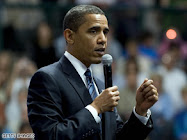
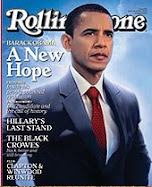
This report in the Miami Herald tells the story of what this election SHOULD look like. This election should be no less a transition than that of 1932 (FDR) or 1980 (Ronald Reagan). This election should be a fundamental realignment in American politics. There is no reason to contemplate even the POSSIBILITY of an Obama loss. As things stand unless something calamatous takes place Barack is going win -- BIG!
The only intelligent alternative in this election is Barack Obama and everyone knows that. For those who don't, their reality is based upon something else, certainly not intelligence. It might be racism. It might be abortion. Intelligence it will not be. That was the case before the fall of American capitalism and it is even more more so today.
Americans black and white will be outraged if he is defeated. If this hope is vanquished America will be in total disarray. That is the danger. America will not take a stolen opportunity sitting down. More of the same is unacceptable. This will be one "stolen election" too many.
This story by the Herald makes clear that this election should be a landslide that relegates conservatism and the Republican party to the dust bin of history!!! RGN
Posted on Sun, Oct. 12, 2008
Nov. 4 could bring seismic shift to political landscape
BY STEVEN THOMMA
Barring a dramatic change in the political landscape over the next three weeks, Democrats appear headed toward a decisive victory on Election Day that would give them broad power over the federal government.
Polls, both nationally and in battleground states, increasingly point to a win that would send Barack Obama to the White House and give him larger Democratic majorities in both the House of Representatives and the Senate -- and perhaps a filibuster-proof margin there.
That could mark a historic realignment of the country's politics on a par with 1932 or 1980, when the out party was given power it held for a generation, and used it to transform government's role in American society.
Of course, a lot can change in the final three weeks of the campaign -- one that has already seen volatile shifts in the fortunes of Obama and Republican rival John McCain. And some observers would cite polls that erroneously pointed to a New Hampshire primary win for Obama over Hillary Clinton, or the Election Day exit polls in 2004 that incorrectly suggested a John Kerry victory over President Bush.
Still, as things stand now, Obama, a 47-year-old first-term senator from Illinois, is well positioned to win the Electoral College. He's comfortably holding most of the ''blue'' states that went for Democrats Al Gore and Kerry in past elections, polls show, and he's gaining momentum to take away several ''red'' states that have voted Republican in recent elections, including Florida, Ohio, Colorado and Virginia.
The Democrats are also widely expected to take big gains in House and Senate races.
Like Obama, they're reaching deep into once solid Republican territory. Even such stalwarts as North Carolina Sen. Elizabeth Dole and Kentucky Sen. Mitch McConnell, the Senate Republican leader, could be in jeopardy.
Building on the Democrats' sweeping wins two years ago when they seized control of both chambers of Congress, big gains this year would be reminiscent of the Republican gains in 1978 and 1980 that delivered ``the Reagan Revolution.''
Former Reagan political advisor Ed Rollins likened today's landscape to 1980's, when voters were angry at President Jimmy Carter and the Democrats, and turned to Ronald Reagan in droves once they felt comfortable with the idea of him as president.
''Barack has met the threshold,'' Rollins said. ``Once Reagan met the threshold, people wanted to get rid of Carter and they did in a landslide. This is going to turn into a landslide.''
THE WRONG TRACK
Democrats already had a political advantage heading into the fall campaign, with just 9 percent of Americans thinking the country is on the right track, the lowest ever recorded. President Bush's approval rating last week was only a point higher than Richard Nixon's on the day he was forced to resign from office, reflecting voter anger at Republicans as the party controlling the White House.
Add the collapse of stock prices and anxiety about the economy, and polls show public opinion surging in favor of Democrats.
''The fundamentals have come together almost perfectly and at just the right moment for the Democrats,'' said Larry Sabato, director of the Center for Politics at the University of Virginia. ``It could hardly look better for the Democrats.''
''This election right now is exclusively about the economy,'' said independent analyst Charlie Cook. ``Despite the fact that the House and Senate are in Democratic hands, Republicans seem to have total ownership of the problem. Fair or not, it's true.''
NONSTARTERS
It's also made it much more difficult for McCain to score with his escalating attacks on Obama for his ties to such controversial figures as William Ayers, a former member of a violent Vietnam-era protest group. ''You can't break through with the economy being so overwhelming,'' Rollins said. ``No one cares.''
Obama's strength is evident on the political map.
Confident of holding all the states that went for Kerry in 2004, Obama's playing offense in several Republican states. He has an edge or is competitive in such states as:
• Colorado, where he's up by an average of 4 percentage points, according to recent polls there compiled by RealClearPolitics.com.
• Florida, where he's up by 3.8 percentage points.
• Nevada, where he's up by three points.
• Ohio, where he's up by 2.7 points.
• Virginia, where's up by 6.3 points.
Most of those are still close enough to be considered tossups.
OBAMA OVER THE HUMP
But as of last week, Obama now leads in enough states to secure more than the 270 Electoral College votes needed to win the presidency.
He could lose some of those leads, of course. There's still one more presidential debate on Wednesday. And events could change. A terrorist attack, for example, could turn voters back to McCain's political strength: his standing on foreign policy and national security.
''But I don't know if even that would work,'' Cook said. ``It's not like people would forget their pocketbooks.''
Democrats also are expected to expand their majority in the House, which they now control 235-199 with one vacancy, and in the Senate, which they control 51-49 with the support of two independents.
Three renowned analysts of congressional races -- Cook, Sabato and Stuart Rothenberg -- last week all increased their forecasts of Democratic congressional gains.
In the House, they expect the Democrats to pick up 15 to 30 seats. In the Senate, they expect the Democrats to pick up six to nine.
''I now can't rule out 60 seats for this November,'' Rothenberg said. That's the magic number a majority needs under Senate rules to break filibusters -- and something that no party or president has enjoyed for nearly three decades.
GOP SEATS VULNERABLE
The analysts tend to agree that the Democrats are all but certain to pick up Senate seats in New Mexico and Virginia. Other potential gains are in Alaska, Colorado, New Hampshire, Oregon, Minnesota, Mississippi, Kentucky and North Carolina.
In North Carolina, Dole trails by an average of two percentage points. In Kentucky, McConnell leads by an average of just seven points -- he won by 65 percent to 35 percent in 2002.
Even in solidly Republican Georgia, Sen. Saxby Chambliss finds himself in a fight.
''When you're paying attention to Georgia and Kentucky, wow,'' Cook said. ``Who would have thought Republicans would be having problems in places like this?''
Added Rothenberg: ``Republicans appear to be heading into a disastrous election that will usher in a very bleak period for the party. A new generation of party leaders will have to figure out how to pick up the pieces and make their party relevant after November.''
________________________________________
© 2008 Miami Herald Media Company. All Rights Reserved.
http://www.miamiherald.com
Sunday, October 12, 2008


McCain's Desperation: Barack as Terrorist

These McCain/Palin rallies have been nothing more than an appeal to white nationslism. White nationalism runs deep in America's history. White nationalism is at its core. What the attack on Obama has been is to make him out to be an enemy of America. We are talking about someone running to be president of the United States of America. By questioning his patriotism, the McCain campaign is making Barack a target. It has gotten so outrageous that McCain is being booed by his followers for backing away from his extremism.
Some months ago, I was taking on colleagues for being cynical even to the point of opposing the Obama candidacy because his success might be a detriment to battling racism is America. For many of these intellectuals, Obama's success interfered with their "road to victory" against racism. As such, his so-called "post-racial" candidacy was perceived to be a danger, even more so if he lost.
It is begining to appear that the real danger of the Obama candidacy will not be as a result of its capitulation to racism but its overcoming racism to the point that his candidacy is successful. (For anyone who questions about where he stands on the issues, visit www.barackobama.com.) Obviously, white nationalists, including "mainstream" pundits like Pat Buchanan, think that it is their patriotic duty to defeat Barack -- no matter their rhetoric and deeds. They are a cover for the real right wing white supremacist nuts. The question is will THESE white nationalists accept a black man as president? That is the danger. Such a danger increases as the right wing rhetoric becomes more extreme and economic conditions worsen.
Frank Rich sees similar problems with the McCain campaign. RGN
The Terrorist Barack Hussein Obama
Frank Rich
Some voters told reporters that they didn’t want Obama to run, let alone win, should his very presence unleash the demons who have stalked America from Lincoln to King.
After consultation with Congress, Michael Chertoff, the homeland security secretary, gave Obama a Secret Service detail earlier than any presidential candidate in our history — in May 2007, some eight months before the first Democratic primaries.
“I’ve got the best protection in the world, so stop worrying,” Obama reassured his supporters. Eventually the country got conditioned to his appearing in large arenas without incident (though I confess that the first loud burst of fireworks at the end of his convention stadium speech gave me a start). In America, nothing does succeed like success. The fear receded.
Until now. At McCain-Palin rallies, the raucous and insistent cries of “Treason!” and “Terrorist!” and “Kill him!” and “Off with his head!” as well as the uninhibited slinging of racial epithets, are actually something new in a campaign that has seen almost every conceivable twist. They are alarms. Doing nothing is not an option.
All’s fair in politics. John McCain and Sarah Palin have every right to bring up William Ayers, even if his connection to Obama is minor, even if Ayers’s Weather Underground history dates back to Obama’s childhood, even if establishment Republicans and Democrats alike have collaborated with the present-day Ayers in educational reform. But it’s not just the old Joe McCarthyesque guilt-by-association game, however spurious, that’s going on here. Don’t for an instant believe the many mindlessly “even-handed” journalists who keep saying that the McCain campaign’s use of Ayers is the moral or political equivalent of the Obama campaign’s hammering on Charles Keating.
What makes them different, and what has pumped up the Weimar-like rage at McCain-Palin rallies, is the violent escalation in rhetoric, especially (though not exclusively) by Palin. Obama “launched his political career in the living room of a domestic terrorist.” He is “palling around with terrorists” (note the plural noun).
Obama is “not a man who sees America the way you and I see America.” Wielding a wildly out-of-context Obama quote, Palin slurs him as an enemy of American troops.
By the time McCain asks the crowd “Who is the real Barack Obama?” it’s no surprise that someone cries out “Terrorist!” The rhetorical conflation of Obama with terrorism is complete. It is stoked further by the repeated invocation of Obama’s middle name by surrogates introducing McCain and Palin at these rallies. This sleight of hand at once synchronizes with the poisonous Obama-is-a-Muslim e-mail blasts and shifts the brand of terrorism from Ayers’s Vietnam-era variety to the radical Islamic threats of today.
That’s a far cry from simply accusing Obama of being a guilty-by-association radical leftist. Obama is being branded as a potential killer and an accessory to past attempts at murder. “Barack Obama’s friend tried to kill my family” was how a McCain press release last week packaged the remembrance of a Weather Underground incident from 1970 — when Obama was 8.
We all know what punishment fits the crime of murder, or even potential murder, if the security of post-9/11 America is at stake. We all know how self-appointed “patriotic” martyrs always justify taking the law into their own hands.
Obama can hardly be held accountable for Ayers’s behavior 40 years ago, but at least McCain and Palin can try to take some responsibility for the behavior of their own supporters in 2008. What’s troubling here is not only the candidates’ loose inflammatory talk but also their refusal to step in promptly and strongly when someone responds to it with bloodthirsty threats in a crowded arena. Joe Biden had it exactly right when he expressed concern last week that “a leading American politician who might be vice president of the United States would not just stop midsentence and turn and condemn that.” To stay silent is to pour gas on the fires.
It wasn’t always thus with McCain. In February he loudly disassociated himself from a speaker who brayed “Barack Hussein Obama” when introducing him at a rally in Ohio. Now McCain either backpedals with tardy, pro forma expressions of respect for his opponent or lets second-tier campaign underlings release boilerplate disavowals after ugly incidents like the chilling Jim Crow-era flashback last week when a Florida sheriff ranted about “Barack Hussein Obama” at a Palin rally while in full uniform.
From the start, there have always been two separate but equal questions about race in this election. Is there still enough racism in America to prevent a black man from being elected president no matter what? And, will Republicans play the race card? The jury is out on the first question until Nov. 4. But we now have the unambiguous answer to the second: Yes.
McCain, who is no racist, turned to this desperate strategy only as Obama started to pull ahead. The tone was set at the Republican convention, with Rudy Giuliani’s mocking dismissal of Obama as an “only in America” affirmative-action baby. We also learned then that the McCain campaign had recruited as a Palin handler none other than Tucker Eskew, the South Carolina consultant who had worked for George W. Bush in the notorious 2000 G.O.P. primary battle where the McCains and their adopted Bangladeshi daughter were slimed by vicious racist rumors.
No less disconcerting was a still-unexplained passage of Palin’s convention speech: Her use of an unattributed quote praising small-town America (as opposed to, say, Chicago and its community organizers) from Westbrook Pegler, the mid-century Hearst columnist famous for his anti-Semitism, racism and violent rhetorical excess. After an assassin tried to kill F.D.R. at a Florida rally and murdered Chicago’s mayor instead in 1933, Pegler wrote that it was “regrettable that Giuseppe Zangara shot the wrong man.” In the ’60s, Pegler had a wish for Bobby Kennedy: “Some white patriot of the Southern tier will spatter his spoonful of brains in public premises before the snow falls.”
This is the writer who found his way into a speech by a potential vice president at a national political convention. It’s astonishing there’s been no demand for a public accounting from the McCain campaign. Imagine if Obama had quoted a Black Panther or Louis Farrakhan — or William Ayers — in Denver.
The operatives who would have Palin quote Pegler have been at it ever since. A key indicator came two weeks after the convention, when the McCain campaign ran its first ad tying Obama to the mortgage giant Fannie Mae. Rather than make its case by using a legitimate link between Fannie and Obama (or other Democratic leaders), the McCain forces chose a former Fannie executive who had no real tie to Obama or his campaign but did have a black face that could dominate the ad’s visuals.
There are no black faces high in the McCain hierarchy to object to these tactics. There hasn’t been a single black Republican governor, senator or House member in six years. This is a campaign where Palin can repeatedly declare that Alaska is “a microcosm of America” without anyone even wondering how that might be so for a state whose tiny black and Hispanic populations are each roughly one-third the national average. There are indeed so few people of color at McCain events that a black senior writer from The Tallahassee Democrat was mistakenly ejected by the Secret Service from a campaign rally in Panama City in August, even though he was standing with other reporters and showed his credentials. His only apparent infraction was to look glaringly out of place.
Could the old racial politics still be determinative? I’ve long been skeptical of the incessant press prognostications (and liberal panic) that this election will be decided by racist white men in the Rust Belt. Now even the dimmest bloviators have figured out that Americans are riveted by the color green, not black — as in money, not energy. Voters are looking for a leader who might help rescue them, not a reckless gambler whose lurching responses to the economic meltdown (a campaign “suspension,” a mortgage-buyout stunt that changes daily) are as unhinged as his wanderings around the debate stage.
To see how fast the tide is moving, just look at North Carolina. On July 4 this year — the day that the godfather of modern G.O.P. racial politics, Jesse Helms, died — The Charlotte Observer reported that strategists of both parties agreed Obama’s chances to win the state fell “between slim and none.” Today, as Charlotte reels from the implosion of Wachovia, the McCain-Obama race is a dead heat in North Carolina and Helms’s Republican successor in the Senate, Elizabeth Dole, is looking like a goner.
But we’re not at Election Day yet, and if voters are to have their final say, both America and Obama have to get there safely. The McCain campaign has crossed the line between tough negative campaigning and inciting vigilantism, and each day the mob howls louder. The onus is on the man who says he puts his country first to call off the dogs, pit bulls and otherwise.
John Lewis on McCain Sowing Seeds of Division
John McCain is running a campaign that appeals to white nationalism and Congressman John Lewis called him out on it. By painting Barack as being unpatriotic by “palling around with domestic terrorists” and being “dangerous,” McCain and Palin are questioning his loyalty to white nationalism, no matter how much he loves and is devoted to a better America.
McCain said at the values forum said that John Lewis is one of the people he most admires for his courage and morals. That same Lewis has now criticized the appeals to white nationalism that have become the central feature of the McCain campaign. Lewis suggested that McCain’s seeds of division were reminiscent of George Wallace. Lewis was right to warn McCain. Because he was compared to George Wallace, the McCain campaign demanded that Barack disavow Lewis’ comments.
The truth is that one does not go back to George Wallace to find the Republican appeal to white nationalism. Recall that Reagan opened his presidential bid in Philadelphia, Mississippi, the site of the murders of Chaney, Goodman, and Schwerner. Reagan and his Republicans opposed sanctions for South Africa. He opposed the 1964 Civil Rights Act. He tried to weaken the 1965 Voting Rights Act. He opposed the national holiday for King. The “Reagan Revolution” was based on white nationalism and division.
The McCain/Palin campaign is just following the tradition of Donald Segretti, Lee Atwater, and Karl Rove. RGN
John Lewis Warns McCain: You're "Sowing The Seeds Of Hatred And Division"
Georgia congressman and Civil Rights leader John Lewis, reacting to the increasingly incendiary atmosphere at McCain-Palin campaign rallies, condemned the GOP for using tactics that are creating a mood not unlike the one created by George Wallace, the former segregationist governor and presidential candidate. Lewis accused the Republicans of "sowing the seeds of hatred and division," and warned the McCain
campaign that they are "playing with fire:"
"As one who was a victim of violence and hate during the height of the Civil Rights Movement, I am deeply disturbed by the negative tone of the McCain-Palin campaign," Lewis said in a statement. "Sen. McCain and Gov. Palin are sowing the seeds of hatred and division, and there is no need for this hostility in our political discourse."
The veteran Democrat even invoked one of the most divisive figures in recent U.S. history. "During another period, in the not too distant past, there was a governor of the state of Alabama named George Wallace who also became a presidential candidate. George Wallace never threw a bomb. He never fired a gun, but he created the climate and the conditions that encouraged vicious attacks against innocent Americans who were simply trying to exercise their constitutional rights. Because of this atmosphere of hate, four little girls were killed on Sunday morning when a church was bombed in Birmingham, Alabama," said Lewis.
He warned, "As public figures with the power to influence and persuade, Sen. McCain and Gov. Palin are playing with fire, and if they are not careful, that fire will consume us all. They are playing a very dangerous game that disregards the value of the political process and cheapens our entire democracy. We can do better. The American people deserve better."
McCain said at the values forum said that John Lewis is one of the people he most admires for his courage and morals. That same Lewis has now criticized the appeals to white nationalism that have become the central feature of the McCain campaign. Lewis suggested that McCain’s seeds of division were reminiscent of George Wallace. Lewis was right to warn McCain. Because he was compared to George Wallace, the McCain campaign demanded that Barack disavow Lewis’ comments.
The truth is that one does not go back to George Wallace to find the Republican appeal to white nationalism. Recall that Reagan opened his presidential bid in Philadelphia, Mississippi, the site of the murders of Chaney, Goodman, and Schwerner. Reagan and his Republicans opposed sanctions for South Africa. He opposed the 1964 Civil Rights Act. He tried to weaken the 1965 Voting Rights Act. He opposed the national holiday for King. The “Reagan Revolution” was based on white nationalism and division.
The McCain/Palin campaign is just following the tradition of Donald Segretti, Lee Atwater, and Karl Rove. RGN
John Lewis Warns McCain: You're "Sowing The Seeds Of Hatred And Division"
Georgia congressman and Civil Rights leader John Lewis, reacting to the increasingly incendiary atmosphere at McCain-Palin campaign rallies, condemned the GOP for using tactics that are creating a mood not unlike the one created by George Wallace, the former segregationist governor and presidential candidate. Lewis accused the Republicans of "sowing the seeds of hatred and division," and warned the McCain
campaign that they are "playing with fire:"
"As one who was a victim of violence and hate during the height of the Civil Rights Movement, I am deeply disturbed by the negative tone of the McCain-Palin campaign," Lewis said in a statement. "Sen. McCain and Gov. Palin are sowing the seeds of hatred and division, and there is no need for this hostility in our political discourse."
The veteran Democrat even invoked one of the most divisive figures in recent U.S. history. "During another period, in the not too distant past, there was a governor of the state of Alabama named George Wallace who also became a presidential candidate. George Wallace never threw a bomb. He never fired a gun, but he created the climate and the conditions that encouraged vicious attacks against innocent Americans who were simply trying to exercise their constitutional rights. Because of this atmosphere of hate, four little girls were killed on Sunday morning when a church was bombed in Birmingham, Alabama," said Lewis.
He warned, "As public figures with the power to influence and persuade, Sen. McCain and Gov. Palin are playing with fire, and if they are not careful, that fire will consume us all. They are playing a very dangerous game that disregards the value of the political process and cheapens our entire democracy. We can do better. The American people deserve better."
Donna Brazile: I am not going to the back of the bus!!!
On Saturday, October 4th, Jeffrey Toobin hosted a panel discussion with Donna Brazile, Alex Castellanos, Edward J. Rollins, and Joe Trippi. As reported earlier, Brazile stole the show. Watch Brazile’s impassioned closing remarks below. The full length video is also available.
Noam Chomsky: Capitalism in Crisis and the Presidential Campaign
Anti-Democratic Nature of US Capitalism is Being Exposed
Bretton Woods was the system of global financial
management set up at the end of the second World War
to ensure the interests of capital did not smother
wider social concerns in post-war democracies. It
was hated by the US neoliberals - the very people
who created the banking crisis writes Noam Chomsky
By Noam Chomsky
The Irish Times
October 10, 2008
The simultaneous unfolding of the US presidential campaign and unraveling of the financial markets presents one of those occasions where the political and economic systems starkly reveal their nature.
Passion about the campaign may not be universally shared but almost everybody can feel the anxiety from the foreclosure of a million homes, and concerns about jobs, savings and healthcare at risk.
The initial Bush proposals to deal with the crisis so reeked of totalitarianism that they were quickly modified. Under intense lobbyist pressure, they were reshaped as "a clear win for the largest institutions in the system . . . a way of dumping assets without having to fail or close", as described by James Rickards, who negotiated the federal bailout for the hedge fund Long Term Capital Management in 1998, reminding us that we are treading familiar turf. The immediate origins of the current meltdown lie in the collapse of the housing bubble supervised by Federal Reserve chairman Alan Greenspan, which sustained the struggling economy through the Bush years by debt-based consumer spending along with borrowing from abroad. But the roots are deeper. In part they lie in the triumph of financial liberalisation in the past 30 years - that is, freeing the markets as much as possible from government regulation.
These steps predictably increased the frequency and depth of severe reversals, which now threaten to bring about the worst crisis since the Great Depression.
Also predictably, the narrow sectors that reaped enormous profits from liberalisation are calling for massive state intervention to rescue collapsing financial institutions.
Such interventionism is a regular feature of state capitalism, though the scale today is unusual. A study by international economists Winfried Ruigrok and Rob van Tulder 15 years ago found that at least 20 companies in the Fortune 100 would not have survived if they had not been saved by their respective governments, and that many of the rest gained substantially by demanding that governments "socialise their losses," as in today's taxpayer-financed bailout.
Such government intervention "has been the rule rather than the exception over the past two centuries", they conclude.
In a functioning democratic society, a political campaign would address such fundamental issues, looking into root causes and cures, and proposing the means by which people suffering the consequences can take effective control.
The financial market "underprices risk" and is "systematically inefficient", as economists John Eatwell and Lance Taylor wrote a decade ago, warning of
the extreme dangers of financial liberalisation and reviewing the substantial costs already incurred - and proposing solutions, which have been ignored. One factor is failure to calculate the costs to those who do not participate in transactions. These "externalities" can be huge. Ignoring systemic risk leads to more risk-taking than would take place in an efficient economy, even by the narrowest measures.
The task of financial institutions is to take risks and, if well-managed, to ensure that potential losses to themselves will be covered. The emphasis is on "to themselves". Under state capitalist rules, it is not their business to consider the cost to others - the "externalities" of decent survival - if their practices lead to financial crisis, as they regularly do.
Financial liberalisation has effects well beyond the economy. It has long been understood that it is a powerful weapon against democracy. Free capital
movement creates what some have called a "virtual parliament" of investors and lenders, who closely monitor government programmes and "vote" against them if they are considered irrational: for the benefit of people, rather than concentrated private power.
Investors and lenders can "vote" by capital flight, attacks on currencies and other devices offered by financial liberalisation. That is one reason why the
Bretton Woods system established by the United States and Britain after the second World War instituted capital controls and regulated currencies.*
The Great Depression and the war had aroused powerful radical democratic currents, ranging from the anti-fascist resistance to working class organisation. These pressures made it necessary to permit social democratic policies. The Bretton Woods system was designed in part to create a space for government action responding to public will - for some measure of democracy.
John Maynard Keynes, the British negotiator, considered the most important achievement of Bretton Woods to be the establishment of the right of governments to restrict capital movement.
In dramatic contrast, in the neoliberal phase after the breakdown of the Bretton Woods system in the 1970s, the US treasury now regards free capital mobility as a "fundamental right", unlike such alleged "rights" as those guaranteed by the Universal Declaration of Human Rights: health, education, decent employment, security and other rights that the Reagan and Bush administrations have dismissed as "letters to Santa Claus", "preposterous", mere "myths".
In earlier years, the public had not been much of a problem. The reasons are reviewed by Barry Eichengreen in his standard scholarly history of the international monetary system. He explains that in the 19th century, governments had not yet been "politicised by universal male suffrage and the rise of trade unionism and parliamentary labour parties". Therefore, the severe costs imposed by the virtual parliament could be transferred to the general population.
But with the radicalisation of the general public during the Great Depression and the anti-fascist war, that luxury was no longer available to private power and wealth. Hence in the Bretton Woods system, "limits on capital mobility substituted for limits on democracy as a source of insulation from market pressures".
The obvious corollary is that after the dismantling of the postwar system, democracy is restricted. It has therefore become necessary to control and marginalise the public in some fashion, processes particularly evident in the more business-run societies like the United States. The management of electoral extravaganzas by the public relations industry is one illustration.
"Politics is the shadow cast on society by big business," concluded America's leading 20th century social philosopher John Dewey, and will remain so as
long as power resides in "business for private profit through private control of banking, land, industry, reinforced by command of the press, press agents and other means of publicity and propaganda".
The United States effectively has a one-party system, the business party, with two factions, Republicans and Democrats. There are differences between them. In his study Unequal Democracy: The Political Economy of the New Gilded Age, Larry Bartels shows that during the past six decades "real incomes of middle-class families have grown twice as fast under Democrats as they have under Republicans, while the real incomes of working-poor families have grown six times as fast under Democrats as they have under Republicans".
Differences can be detected in the current election as well. Voters should consider them, but without illusions about the political parties, and with the recognition that consistently over the centuries, progressive legislation and social welfare have been won by popular struggles, not gifts from above.
Those struggles follow a cycle of success and setback. They must be waged every day, not just once every four years, always with the goal of creating a genuinely responsive democratic society, from the voting booth to the workplace.
* The Bretton Woods system of global financial
management was created by 730 delegates from all 44
Allied second World War nations who attended a UN-
hosted Monetary and Financial Conference at the Mount
Washington Hotel in Bretton Woods in New Hampshire in
1944.
Bretton Woods, which collapsed in 1971, was the
system of rules, institutions, and procedures that
regulated the international monetary system, under
which were set up the International Bank for
Reconstruction and Development (IBRD) (now one of
five institutions in the World Bank Group) and the
International Monetary Fund (IMF), which came into
effect in 1945.
The chief feature of Bretton Woods was an obligation
for each country to adopt a monetary policy that
maintained the exchange rate of its currency within a
fixed value.
The system collapsed when the US suspended
convertibility from dollars to gold. This created the
unique situation whereby the US dollar became the
"reserve currency" for the other countries within
Bretton Woods.
(c) 2008 The Irish Times
http://www.irishtimes.com/newspaper/opinion/2008/1010/1223560345968.html
Bretton Woods was the system of global financial
management set up at the end of the second World War
to ensure the interests of capital did not smother
wider social concerns in post-war democracies. It
was hated by the US neoliberals - the very people
who created the banking crisis writes Noam Chomsky
By Noam Chomsky
The Irish Times
October 10, 2008
The simultaneous unfolding of the US presidential campaign and unraveling of the financial markets presents one of those occasions where the political and economic systems starkly reveal their nature.
Passion about the campaign may not be universally shared but almost everybody can feel the anxiety from the foreclosure of a million homes, and concerns about jobs, savings and healthcare at risk.
The initial Bush proposals to deal with the crisis so reeked of totalitarianism that they were quickly modified. Under intense lobbyist pressure, they were reshaped as "a clear win for the largest institutions in the system . . . a way of dumping assets without having to fail or close", as described by James Rickards, who negotiated the federal bailout for the hedge fund Long Term Capital Management in 1998, reminding us that we are treading familiar turf. The immediate origins of the current meltdown lie in the collapse of the housing bubble supervised by Federal Reserve chairman Alan Greenspan, which sustained the struggling economy through the Bush years by debt-based consumer spending along with borrowing from abroad. But the roots are deeper. In part they lie in the triumph of financial liberalisation in the past 30 years - that is, freeing the markets as much as possible from government regulation.
These steps predictably increased the frequency and depth of severe reversals, which now threaten to bring about the worst crisis since the Great Depression.
Also predictably, the narrow sectors that reaped enormous profits from liberalisation are calling for massive state intervention to rescue collapsing financial institutions.
Such interventionism is a regular feature of state capitalism, though the scale today is unusual. A study by international economists Winfried Ruigrok and Rob van Tulder 15 years ago found that at least 20 companies in the Fortune 100 would not have survived if they had not been saved by their respective governments, and that many of the rest gained substantially by demanding that governments "socialise their losses," as in today's taxpayer-financed bailout.
Such government intervention "has been the rule rather than the exception over the past two centuries", they conclude.
In a functioning democratic society, a political campaign would address such fundamental issues, looking into root causes and cures, and proposing the means by which people suffering the consequences can take effective control.
The financial market "underprices risk" and is "systematically inefficient", as economists John Eatwell and Lance Taylor wrote a decade ago, warning of
the extreme dangers of financial liberalisation and reviewing the substantial costs already incurred - and proposing solutions, which have been ignored. One factor is failure to calculate the costs to those who do not participate in transactions. These "externalities" can be huge. Ignoring systemic risk leads to more risk-taking than would take place in an efficient economy, even by the narrowest measures.
The task of financial institutions is to take risks and, if well-managed, to ensure that potential losses to themselves will be covered. The emphasis is on "to themselves". Under state capitalist rules, it is not their business to consider the cost to others - the "externalities" of decent survival - if their practices lead to financial crisis, as they regularly do.
Financial liberalisation has effects well beyond the economy. It has long been understood that it is a powerful weapon against democracy. Free capital
movement creates what some have called a "virtual parliament" of investors and lenders, who closely monitor government programmes and "vote" against them if they are considered irrational: for the benefit of people, rather than concentrated private power.
Investors and lenders can "vote" by capital flight, attacks on currencies and other devices offered by financial liberalisation. That is one reason why the
Bretton Woods system established by the United States and Britain after the second World War instituted capital controls and regulated currencies.*
The Great Depression and the war had aroused powerful radical democratic currents, ranging from the anti-fascist resistance to working class organisation. These pressures made it necessary to permit social democratic policies. The Bretton Woods system was designed in part to create a space for government action responding to public will - for some measure of democracy.
John Maynard Keynes, the British negotiator, considered the most important achievement of Bretton Woods to be the establishment of the right of governments to restrict capital movement.
In dramatic contrast, in the neoliberal phase after the breakdown of the Bretton Woods system in the 1970s, the US treasury now regards free capital mobility as a "fundamental right", unlike such alleged "rights" as those guaranteed by the Universal Declaration of Human Rights: health, education, decent employment, security and other rights that the Reagan and Bush administrations have dismissed as "letters to Santa Claus", "preposterous", mere "myths".
In earlier years, the public had not been much of a problem. The reasons are reviewed by Barry Eichengreen in his standard scholarly history of the international monetary system. He explains that in the 19th century, governments had not yet been "politicised by universal male suffrage and the rise of trade unionism and parliamentary labour parties". Therefore, the severe costs imposed by the virtual parliament could be transferred to the general population.
But with the radicalisation of the general public during the Great Depression and the anti-fascist war, that luxury was no longer available to private power and wealth. Hence in the Bretton Woods system, "limits on capital mobility substituted for limits on democracy as a source of insulation from market pressures".
The obvious corollary is that after the dismantling of the postwar system, democracy is restricted. It has therefore become necessary to control and marginalise the public in some fashion, processes particularly evident in the more business-run societies like the United States. The management of electoral extravaganzas by the public relations industry is one illustration.
"Politics is the shadow cast on society by big business," concluded America's leading 20th century social philosopher John Dewey, and will remain so as
long as power resides in "business for private profit through private control of banking, land, industry, reinforced by command of the press, press agents and other means of publicity and propaganda".
The United States effectively has a one-party system, the business party, with two factions, Republicans and Democrats. There are differences between them. In his study Unequal Democracy: The Political Economy of the New Gilded Age, Larry Bartels shows that during the past six decades "real incomes of middle-class families have grown twice as fast under Democrats as they have under Republicans, while the real incomes of working-poor families have grown six times as fast under Democrats as they have under Republicans".
Differences can be detected in the current election as well. Voters should consider them, but without illusions about the political parties, and with the recognition that consistently over the centuries, progressive legislation and social welfare have been won by popular struggles, not gifts from above.
Those struggles follow a cycle of success and setback. They must be waged every day, not just once every four years, always with the goal of creating a genuinely responsive democratic society, from the voting booth to the workplace.
* The Bretton Woods system of global financial
management was created by 730 delegates from all 44
Allied second World War nations who attended a UN-
hosted Monetary and Financial Conference at the Mount
Washington Hotel in Bretton Woods in New Hampshire in
1944.
Bretton Woods, which collapsed in 1971, was the
system of rules, institutions, and procedures that
regulated the international monetary system, under
which were set up the International Bank for
Reconstruction and Development (IBRD) (now one of
five institutions in the World Bank Group) and the
International Monetary Fund (IMF), which came into
effect in 1945.
The chief feature of Bretton Woods was an obligation
for each country to adopt a monetary policy that
maintained the exchange rate of its currency within a
fixed value.
The system collapsed when the US suspended
convertibility from dollars to gold. This created the
unique situation whereby the US dollar became the
"reserve currency" for the other countries within
Bretton Woods.
(c) 2008 The Irish Times
http://www.irishtimes.com/newspaper/opinion/2008/1010/1223560345968.html
Saturday, October 11, 2008
Making Use of Public Access...
"Democracy Matters" is a public access presentation produced by the Isabella County Democratic Party. John Dinse is professor emeritus at Central Michigan University's political science department. Angela Haddad is Associate Professor and Chair of Central Michigan University's Sociology, Anthropology and Social Work department. It is this department that is my home department. A local party member and activist John Barker is the producer of the presentation. RGN
See left panel for link: Democracy Matters on the Obama campaign
See left panel for link: Democracy Matters on the Obama campaign
Bob Herbert: Racist History of the Republicans Revealed

As Andrew Hacker makes clear in his book, Two Nations: Black, White, Separate, Unequal and Hostile, the Republican party sees itself as the party to protect the interests whites. More importantly, the issues that Bob Herbert discusses below are much broader than race. The policies and discourse of the Republicans have not served America well. Their pandering is now being exposed for what is was. Their policies have been lies and failures for nearly 30 years. Bob Herbert sees the mask as having slipped. RGN
October 11, 2008
Op-Ed Columnist
The Mask Slips
By BOB HERBERT
The lesson for Americans suffused with anxiety and dread over the crackup of the financial markets is that the way you vote matters, that there are real-world consequences when you go into a voting booth and cast that ballot.
For the nitwits who vote for the man or woman they’d most like to have over for dinner, or hang out at a barbecue with, I suggest you take a look at how well your 401(k) is doing, or how easy it will be to meet the mortgage this month, or whether the college fund you’ve been trying to build for your kids is as robust as you’d like it to be.
Voters in the George W. Bush era gave the Republican Party nearly complete control of the federal government. Now the financial markets are in turmoil, top government and corporate leaders are on the verge of panic and scholars are dusting off treatises that analyzed the causes of the Great Depression.
Mr. Bush was never viewed as a policy or intellectual heavyweight. But he seemed like a nicer guy to a lot of voters than Al Gore.
It’s not just the economy. While the United States has been fighting a useless and irresponsible war in Iraq, Afghanistan — the home base of the terrorists who struck us on 9/11 — has been allowed to fall into a state of chaos. Osama bin Laden is still at large. New Orleans is still on its knees. And so on.
Voting has consequences.
I don’t for a moment think that the Democratic Party has been free of egregious problems. But there are two things I find remarkable about the G.O.P., and especially its more conservative wing, which is now about all there is.
The first is how wrong conservative Republicans have been on so many profoundly important matters for so many years. The second is how the G.O.P. has nevertheless been able to persuade so many voters of modest means that its wrongheaded, favor-the-rich, country-be-damned approach was not only good for working Americans, but was the patriotic way to go.
Remember voodoo economics? That was the derisive term George H.W. Bush used for Ronald Reagan’s fantasy that he could simultaneously increase defense spending, cut taxes and balance the budget. After Reagan became president (with Mr. Bush as his vice president) the budget deficit — surprise, surprise — soared.
In a moment of unusual candor, Reagan’s own chairman of the Council of Economic Advisers, Martin Feldstein, gave three reasons for the growth of the deficit: the president’s tax cuts, the increased defense spending and the interest on the expanding national debt.
These were the self-proclaimed fiscal conservatives who were behaving so profligately. The budget was balanced and a surplus realized under Bill Clinton, but soon the “fiscal conservatives” were back in the driver’s seat. “Deficits don’t matter,” said Dick Cheney, and the wildest, most reckless of economic rides was on.
Americans, including the Joe Sixpacks, soccer moms and hockey moms, were repeatedly told that the benefits lavished on the highfliers would trickle down to them.
Someday.
Just as they were wrong about trickle down, conservative Republican politicians and their closest buddies in the commentariat have been wrong on one important national issue after another, from Social Security (conservatives opposed it from the start and have been trying to undermine it ever since) to Medicare (Ronald Reagan saw it as the first wave of socialism) to the environment, energy policy and global warming.
When the Nobel Prize in Chemistry was awarded to the discoverers of the link between chlorofluorocarbons and ozone depletion, Tom DeLay, a Republican who would go on to wield enormous power as majority leader in the House, mocked the award as the “Nobel Appeasement Prize.”
Mr. Reagan, the ultimate political hero of so many Republicans, opposed the Civil Rights Act of 1964 and the Voting Rights Act of 1965. In response to the historic Brown v. Board of Education school-desegregation ruling, William F. Buckley, the ultimate intellectual hero of so many Republicans, asserted that whites, being superior, were well within their rights to discriminate against blacks.
“The White community is so entitled,” he wrote, “because, for the time being, it is the advanced race...” He would later repudiate that sentiment, but only after it was clear that his racist view was harmful to himself.
The G.O.P. has done a great job masking the terrible consequences of much that it has stood for over the decades. Now the mask has slipped. As we survey the wreckage of the American economy and the real-life suffering associated with the financial crackup of 2008, it would be well for voters to draw upon the lessons of history and think more seriously about the consequences of the ballots they may cast in the future.
Tuesday, October 7, 2008
The Economy vs Race Among the "Original" Reagan Democrats
It appears that the Reagan Democrats of Macomb County might be waking up after all. Eight Mile Road divides the city of Detroit from its northern suburbs. North and west of Detroit is Oakland county. Oakland county tends to be more diverse than its eastern counterpart, Macomb county. Oakland county is one of the most wealthy counties in the nation. The suburbanization of northwest Detroit reflected a largely Jewish population to Oakland county, as well.
The northeastern suburbanization was largely a working class migration from Hamtramck, a largely Polish city that had been surrounded by the city of Detroit. It was this demographic that populated the northern and eastern migration to the cities of Warren and Sterling Heights in Macomb county. When I was an employee of the Michigan Civil Rights Commission in the late '60s, it was clear that Warren was likely the most racially hostile communities in the Detroit Metropolitan area.
As we have been warned, for the older white vote, Obama's race is likely to be a factor. Recall that the Reagan Democrats were largely working class who had turned to Reagan as a result of his appealing to their racism and the opposition of their union, the UAW's support for King and the Civil Rights Movement. While race is and has been salient for these Reagan Democrats, this report by Chris Christoff of the Detroit Free Press shows that the state of the economy shows that Obama is breaking down some of the barriers. Their self-interests may be trumping their racism. Consequently, more and more Reagan Democrats are coming home to Barack. RGN
Economy topping race for voters along 8 Mile
Worries are similar in Warren and Detroit, but anger, distrust influence views about Obama
Leonatti is 76, white and a two-time Ronald Reagan voter. Smith, 39, is black and a Democrat. Both say they're angry about the economy, and both say they'll vote for Democratic presidential nominee Barack Obama.
"I've had enough of Republicans for the past eight years," Leonatti said. Obama, he added, is "fresh and intelligent."
But Leonatti, interviewed at a Warren doughnut shop amid banter over jobs, the Iraq war and Wall Street, was frank about a sensitive topic: Obama's race.
"A lot of people won't vote for him because he's black," said the Ford Motor Co. retiree who lives in Macomb Township. "That's what they tell me."
In Warren, some Democrats and independents are wary of Obama's experience, patriotism and, without prodding, his race.
Still, a recent study showed some independent-minded Reagan Democrats such as Leonatti, who put Macomb County on the nation's political map in the 1980s, are more worried about the economy than the Democratic candidate's race.
Seven in 10 Macomb County voters listed the economy as their first or second top concern, and gas prices rank second on their lists, a July poll by Greenberg Quinlan Rosner Research of Washington, D.C., showed.
About 1 in 3 said they believed Obama, as president, would make a higher priority of serving the needs of African Americans than others.
In a September poll, Greenberg found that Obama had picked up support from Macomb County's white, union, non-college-educated voters, and had pulled even with Republican John McCain in the presidential race.
Free Press interviews with more than 20 voters on both sides of 8 Mile showed that Obama's candidacy has blurred the lines of geography and race but hasn't made them invisible.
What role race is playing
The race issue has never been far from the surface, often poking through like a knife.
Whether the issue is consequential, though -- with Obama having held big leads in recent Michigan polls and McCain pulling most of his campaign out of the state last week -- is debatable.
Smith, the Detroiter, said he was heartened that Obama has as much support as he does from white Americans. He said Obama understands the financial struggles of average people and represents the nation's future -- more racially and ethnically mixed.
"I think the country's showing a lot of encouragement, standing behind an African American male," said Smith.
Detroiters -- overwhelmingly black and Democratic -- back Obama, just as they've backed past Democratic presidential candidates.
But Obama's race emerged in discussions at a couple of Warren bars.
Ben Maynor, 82, a retiree and Democrat, said he might not vote in the election. He's angry about jobs going overseas and greedy Wall Street financiers. But he doesn't think a black man can run the country.
"I don't know whether to trust them," he said matter-of-factly over an afternoon beer.
A short while later, across the bar, Paul Gowdy, 62, said he'll vote for Obama. Gowdy, an Irish immigrant who voted for Reagan, said race is not a factor.
"I don't hear anyone running him down because of his race," said Gowdy, a retired executive from Comerica Bank. "The biggest thing I hear is his lack of experience."
Inside voters' heads
Race was a force in the Reagan Democrat phenomenon of the 1980s, when traditional, white Democrats in Macomb County bolted for the GOP. Warren, nearly all-white then, had been a center of suburban opposition to efforts to require busing across school district lines to achieve integration.
A pro-McCain group recently ran ads on county cable TV stations that linked Obama to his former minister, the Rev. Jeremiah Wright, and former Detroit Mayor Kwame Kilpatrick. The ads ran nowhere else in Michigan.
Today, Warren remains an overwhelmingly white suburb of about 126,000, with a large number of union households, Catholics and a socially conservative streak. Warren voters have reflected the outcome of Michigan presidential elections since 1976.
It's an automotive haven of blue-collar voters where anxiety boils over high unemployment, home foreclosures, gas prices and the Iraq war.
Truck driver Phil Lilley, 46, calls himself a middle-of-the-road Democrat who might not vote in November. He said he doubts either Obama or McCain will deliver on his promises.
Lilley fears for his job hauling steel to automakers. He said he doesn't oppose Obama because he's black, but many people do.
Detroiter Louis Moore, 82, would agree.
At a northeast Detroit senior center, Moore said he'll vote for Obama, but added, "It ain't time yet for a black man to be president of the United States. Maybe in 100 years."
Retiree Alex Collins, 63, who is black, was optimistic. He said he worries most about the economy and his modest, fixed income. "I feel like it's time," Collins said. "We must try a black man We must try a woman. Why not give either of them a chance?"
Josephine Gentry-Huyghe, an Obama volunteer in Detroit, said she hopes to boost voter turnout on Election Day, noting that she'd just registered a 90-year-old resident.
"I read where one-third of white voters won't vote for a black," Gentry-Huyghe said. "Leave them alone. If we can get enough to cancel out that one-third, that's what we've got to do."
Mike Scozzari, 56, president of the Warren Center Line Democratic Club, said some white voters resent black people for what they perceive as preferential treatment, and that carries over into politics.
"This election, they're being confronted with their own racism -- it's looking them in the eye," Scozzari said "They're asking themselves, 'I want a Democrat to win, but, geez, I can't go in there and pull that lever.' "
He added, "I think they'll come around."
Gut-level decisions
Michigan AFL-CIO President Mark Gaffney acknowledged that racial prejudice among some union members is a concern, and that thousands of union political activists have been trained to disarm prejudice in private conversations with fellow union members by focusing on other issues.
"I'd like to think we're getting to the point where many folks are saying, 'Yep, one candidate's white, one's black, but gosh, we've got to do something about the economy,' " he said.
Mayor James Fouts said Warren will be an election bellwether in Michigan. Voters are more concerned about losing homes to foreclosure and losing their jobs than they are about race, he said.
"A lot of people will make up their mind when they get behind that voting booth, and it will be a gut-level decision," said Fouts, adding that he hasn't decided who he'll support.
Warren resident Edna Saam said she has never voted for a Republican, but she'll vote for McCain. She called Obama too inexperienced and "too showy" in his campaign.
She's unimpressed by McCain's running mate, Sarah Palin, and wishes he had picked someone else.
"I'm watching this election very, very, very closely," said Saam, who gave her age as "senior citizen."
Daniel Mastin, 20, of Warren will vote for the first time, and for Obama. During a break at the A&W restaurant where he works, across from the Warren Chrysler Stamping Plant, he praised Obama's promise to give workers a $1,000 tax rebate. Mastin also likes Obama's plan to raise taxes on wealthy people.
"Look at all the rich people who support Obama -- they don't have a problem with it," Mastin said. "They have the money to pay more. I don't."
Contact CHRIS CHRISTOFF at 517-372-8660 or christoff@freepress.com.
The northeastern suburbanization was largely a working class migration from Hamtramck, a largely Polish city that had been surrounded by the city of Detroit. It was this demographic that populated the northern and eastern migration to the cities of Warren and Sterling Heights in Macomb county. When I was an employee of the Michigan Civil Rights Commission in the late '60s, it was clear that Warren was likely the most racially hostile communities in the Detroit Metropolitan area.
As we have been warned, for the older white vote, Obama's race is likely to be a factor. Recall that the Reagan Democrats were largely working class who had turned to Reagan as a result of his appealing to their racism and the opposition of their union, the UAW's support for King and the Civil Rights Movement. While race is and has been salient for these Reagan Democrats, this report by Chris Christoff of the Detroit Free Press shows that the state of the economy shows that Obama is breaking down some of the barriers. Their self-interests may be trumping their racism. Consequently, more and more Reagan Democrats are coming home to Barack. RGN
Economy topping race for voters along 8 Mile
Worries are similar in Warren and Detroit, but anger, distrust influence views about Obama
Leonatti is 76, white and a two-time Ronald Reagan voter. Smith, 39, is black and a Democrat. Both say they're angry about the economy, and both say they'll vote for Democratic presidential nominee Barack Obama.
"I've had enough of Republicans for the past eight years," Leonatti said. Obama, he added, is "fresh and intelligent."
But Leonatti, interviewed at a Warren doughnut shop amid banter over jobs, the Iraq war and Wall Street, was frank about a sensitive topic: Obama's race.
"A lot of people won't vote for him because he's black," said the Ford Motor Co. retiree who lives in Macomb Township. "That's what they tell me."
In Warren, some Democrats and independents are wary of Obama's experience, patriotism and, without prodding, his race.
Still, a recent study showed some independent-minded Reagan Democrats such as Leonatti, who put Macomb County on the nation's political map in the 1980s, are more worried about the economy than the Democratic candidate's race.
Seven in 10 Macomb County voters listed the economy as their first or second top concern, and gas prices rank second on their lists, a July poll by Greenberg Quinlan Rosner Research of Washington, D.C., showed.
About 1 in 3 said they believed Obama, as president, would make a higher priority of serving the needs of African Americans than others.
In a September poll, Greenberg found that Obama had picked up support from Macomb County's white, union, non-college-educated voters, and had pulled even with Republican John McCain in the presidential race.
Free Press interviews with more than 20 voters on both sides of 8 Mile showed that Obama's candidacy has blurred the lines of geography and race but hasn't made them invisible.
What role race is playing
The race issue has never been far from the surface, often poking through like a knife.
Whether the issue is consequential, though -- with Obama having held big leads in recent Michigan polls and McCain pulling most of his campaign out of the state last week -- is debatable.
Smith, the Detroiter, said he was heartened that Obama has as much support as he does from white Americans. He said Obama understands the financial struggles of average people and represents the nation's future -- more racially and ethnically mixed.
"I think the country's showing a lot of encouragement, standing behind an African American male," said Smith.
Detroiters -- overwhelmingly black and Democratic -- back Obama, just as they've backed past Democratic presidential candidates.
But Obama's race emerged in discussions at a couple of Warren bars.
Ben Maynor, 82, a retiree and Democrat, said he might not vote in the election. He's angry about jobs going overseas and greedy Wall Street financiers. But he doesn't think a black man can run the country.
"I don't know whether to trust them," he said matter-of-factly over an afternoon beer.
A short while later, across the bar, Paul Gowdy, 62, said he'll vote for Obama. Gowdy, an Irish immigrant who voted for Reagan, said race is not a factor.
"I don't hear anyone running him down because of his race," said Gowdy, a retired executive from Comerica Bank. "The biggest thing I hear is his lack of experience."
Inside voters' heads
Race was a force in the Reagan Democrat phenomenon of the 1980s, when traditional, white Democrats in Macomb County bolted for the GOP. Warren, nearly all-white then, had been a center of suburban opposition to efforts to require busing across school district lines to achieve integration.
A pro-McCain group recently ran ads on county cable TV stations that linked Obama to his former minister, the Rev. Jeremiah Wright, and former Detroit Mayor Kwame Kilpatrick. The ads ran nowhere else in Michigan.
Today, Warren remains an overwhelmingly white suburb of about 126,000, with a large number of union households, Catholics and a socially conservative streak. Warren voters have reflected the outcome of Michigan presidential elections since 1976.
It's an automotive haven of blue-collar voters where anxiety boils over high unemployment, home foreclosures, gas prices and the Iraq war.
Truck driver Phil Lilley, 46, calls himself a middle-of-the-road Democrat who might not vote in November. He said he doubts either Obama or McCain will deliver on his promises.
Lilley fears for his job hauling steel to automakers. He said he doesn't oppose Obama because he's black, but many people do.
Detroiter Louis Moore, 82, would agree.
At a northeast Detroit senior center, Moore said he'll vote for Obama, but added, "It ain't time yet for a black man to be president of the United States. Maybe in 100 years."
Retiree Alex Collins, 63, who is black, was optimistic. He said he worries most about the economy and his modest, fixed income. "I feel like it's time," Collins said. "We must try a black man We must try a woman. Why not give either of them a chance?"
Josephine Gentry-Huyghe, an Obama volunteer in Detroit, said she hopes to boost voter turnout on Election Day, noting that she'd just registered a 90-year-old resident.
"I read where one-third of white voters won't vote for a black," Gentry-Huyghe said. "Leave them alone. If we can get enough to cancel out that one-third, that's what we've got to do."
Mike Scozzari, 56, president of the Warren Center Line Democratic Club, said some white voters resent black people for what they perceive as preferential treatment, and that carries over into politics.
"This election, they're being confronted with their own racism -- it's looking them in the eye," Scozzari said "They're asking themselves, 'I want a Democrat to win, but, geez, I can't go in there and pull that lever.' "
He added, "I think they'll come around."
Gut-level decisions
Michigan AFL-CIO President Mark Gaffney acknowledged that racial prejudice among some union members is a concern, and that thousands of union political activists have been trained to disarm prejudice in private conversations with fellow union members by focusing on other issues.
"I'd like to think we're getting to the point where many folks are saying, 'Yep, one candidate's white, one's black, but gosh, we've got to do something about the economy,' " he said.
Mayor James Fouts said Warren will be an election bellwether in Michigan. Voters are more concerned about losing homes to foreclosure and losing their jobs than they are about race, he said.
"A lot of people will make up their mind when they get behind that voting booth, and it will be a gut-level decision," said Fouts, adding that he hasn't decided who he'll support.
Warren resident Edna Saam said she has never voted for a Republican, but she'll vote for McCain. She called Obama too inexperienced and "too showy" in his campaign.
She's unimpressed by McCain's running mate, Sarah Palin, and wishes he had picked someone else.
"I'm watching this election very, very, very closely," said Saam, who gave her age as "senior citizen."
Daniel Mastin, 20, of Warren will vote for the first time, and for Obama. During a break at the A&W restaurant where he works, across from the Warren Chrysler Stamping Plant, he praised Obama's promise to give workers a $1,000 tax rebate. Mastin also likes Obama's plan to raise taxes on wealthy people.
"Look at all the rich people who support Obama -- they don't have a problem with it," Mastin said. "They have the money to pay more. I don't."
Contact CHRIS CHRISTOFF at 517-372-8660 or christoff@freepress.com.
Monday, October 6, 2008
Walters on Obama's Historic Race
2008 Election: Historic, Whether Obama Wins or Looses
By Ron Walters
We may be about to witness what political scientists call a “critical election” which promotes a realignment of American politics – in this case, from Republican to Democrat. But more important than that, it may signal a realignment from the conservative politics that has gripped this country for the past 30 years to a more liberal version going forward. For the racially disadvantaged and economically needy, who need government most, it may signal a return to policies that emphasize investment in human development since the evidence is that the lack of such investment has been the major factor in the fading middle class.
This signals that if there is a difference in the previous administration and what is coming, it will be measured by how the new leaders see the role of government. I’m sure from what he has said, that Barack Obama wants to emphasize personal responsibility, but I am just as sure that he understands the decisive role of government in making sure the opportunities exist that enable people to exercise it.
McCain, however, has followed an ideology which suggests that government does not have much of a role in this, that people should try to exercise their personal responsibility and if they don’t succeed – tough. While that ideology may have been a weapon begun by Ronald Reagan, blunt the force of the Civil Rights movement and to return to the unchallenged supremacy of whites to the racial hierarchy, the record shows that it has also damaged whites, especially, white middle class enormously. So, the issue becomes what kind of change voters really want and which of the candidates they believe can produce it.
If Barack Obama wins, it will undoubtedly be an historic event because of his race and because it may create in some, the idea that America has moved beyond racial evaluations in its determination of what things are important. But race has not always been the determining factor, for if it had, Clarence Thomas would not be sitting on the highest court in the land. Those who sponsored him did so not only because he was black in succeeding Justice Thurgood Marshall, but moiré importantly because he believed in the same things and they could trust him to deliver policy based on that belief.
Obama’s win would signal a generational change, departing from the influence of the “baby boomer” generation moving into post modern America, an America more at ease with race, more comfortable with global culture and the electronic and visual technologies that unites it. Will he be post-racial in his leadership of public policy? I don’t think so, because of his pledges to carry the legacy of the Civil Rights movement into the 21st century, his understanding of racial problems and the fact that presidents also have to respond to problems in the political culture that they didn’t create. So, he will have to respond to the on-going saga of racism which has taken over 400 years to invest in the culture. The caveat one sees, is that his decision will also be based on those around him.
He is in a position to be the leader of an era changing movement, the true characteristics of which are not yet clear, but the seeds of which he has proposed in this campaign, such as more emphasis on environmentalism, concern with domestic productivity and security, promotion of diversity, and collaborative decision making here and abroad.
However, if Barack Obama looses, it will take us in a familiar direction, defined by a primary concern with narrow racial privilege and competition and radical nationalism. The difference between the political parties on issues has favored the Democrats during this election season by an average of as many as 10-15 points on what Americans regard as “most important” issues – war in Iraq, economy, health care, education, terrorism, and etc. in various surveys. The difference between candidates Obama and McCain, however, has rarely been in this range, more like 3-7 points with Obama leading most of the time.
Analysts have suggested that given this relative small difference, he will need a greater lead going into the November election if he is to win, because the racial vote will more than likely reduce his numbers. Thus, there has arisen a debate over whether the so-called “Bradley factor” is alive and well, that is, whether white Americans say they will support a black candidate in polls, but deny him or her support when they cast their vote. Some believe that because the US Senate race of Harold Ford, Jr. turned out close to the poll predictions in 2006 that the Bradley factor no longer exists. We will see.
Black Americans, most assuredly will be disheartened if Barack Obama looses, given the heights that he has ascended thus far in winning the Democratic nomination for president. But their expectations of an historic outcome have been increased as he recovered his lead that McCain had achieved after the Republican Convention with the gloss being removed from his VP pick, Sara Palin, and the “perfect storm” of the economic crisis that is pushing Obama at this very moment into a lead beyond anything he has experienced over McCain. For many, the question has become, “how can he loose?” Others have formulated various versions of the “October surprise” that appeared from time-to-time in elections. Underneath it all, there is the tortuous feeling of many African Americans that America is not quite “America to me” yet, that the use of race will triumph and spoil the dream.
It seems to me that this is the great test that America must pass. Will it forgo the opportunity to affect serious and history-making change both in its racial image and in its support for a new era of human development; or will it re-affirm a narrow vision of America while moving into the gale-force winds of a 21st century needing diversity, humanity, global sensitivity, intellectual acumen and a reasoned nationalism? This is what the 2008 election is about.
Dr. Ron Walters is the Distinguished Leadership Scholar, Director of the African American Leadership Center and Professor of Government and Politics at the University of Maryland College Park. His latest book is: The Price of Racial Reconciliation (University of Michigan Press)
By Ron Walters
We may be about to witness what political scientists call a “critical election” which promotes a realignment of American politics – in this case, from Republican to Democrat. But more important than that, it may signal a realignment from the conservative politics that has gripped this country for the past 30 years to a more liberal version going forward. For the racially disadvantaged and economically needy, who need government most, it may signal a return to policies that emphasize investment in human development since the evidence is that the lack of such investment has been the major factor in the fading middle class.
This signals that if there is a difference in the previous administration and what is coming, it will be measured by how the new leaders see the role of government. I’m sure from what he has said, that Barack Obama wants to emphasize personal responsibility, but I am just as sure that he understands the decisive role of government in making sure the opportunities exist that enable people to exercise it.
McCain, however, has followed an ideology which suggests that government does not have much of a role in this, that people should try to exercise their personal responsibility and if they don’t succeed – tough. While that ideology may have been a weapon begun by Ronald Reagan, blunt the force of the Civil Rights movement and to return to the unchallenged supremacy of whites to the racial hierarchy, the record shows that it has also damaged whites, especially, white middle class enormously. So, the issue becomes what kind of change voters really want and which of the candidates they believe can produce it.
If Barack Obama wins, it will undoubtedly be an historic event because of his race and because it may create in some, the idea that America has moved beyond racial evaluations in its determination of what things are important. But race has not always been the determining factor, for if it had, Clarence Thomas would not be sitting on the highest court in the land. Those who sponsored him did so not only because he was black in succeeding Justice Thurgood Marshall, but moiré importantly because he believed in the same things and they could trust him to deliver policy based on that belief.
Obama’s win would signal a generational change, departing from the influence of the “baby boomer” generation moving into post modern America, an America more at ease with race, more comfortable with global culture and the electronic and visual technologies that unites it. Will he be post-racial in his leadership of public policy? I don’t think so, because of his pledges to carry the legacy of the Civil Rights movement into the 21st century, his understanding of racial problems and the fact that presidents also have to respond to problems in the political culture that they didn’t create. So, he will have to respond to the on-going saga of racism which has taken over 400 years to invest in the culture. The caveat one sees, is that his decision will also be based on those around him.
He is in a position to be the leader of an era changing movement, the true characteristics of which are not yet clear, but the seeds of which he has proposed in this campaign, such as more emphasis on environmentalism, concern with domestic productivity and security, promotion of diversity, and collaborative decision making here and abroad.
However, if Barack Obama looses, it will take us in a familiar direction, defined by a primary concern with narrow racial privilege and competition and radical nationalism. The difference between the political parties on issues has favored the Democrats during this election season by an average of as many as 10-15 points on what Americans regard as “most important” issues – war in Iraq, economy, health care, education, terrorism, and etc. in various surveys. The difference between candidates Obama and McCain, however, has rarely been in this range, more like 3-7 points with Obama leading most of the time.
Analysts have suggested that given this relative small difference, he will need a greater lead going into the November election if he is to win, because the racial vote will more than likely reduce his numbers. Thus, there has arisen a debate over whether the so-called “Bradley factor” is alive and well, that is, whether white Americans say they will support a black candidate in polls, but deny him or her support when they cast their vote. Some believe that because the US Senate race of Harold Ford, Jr. turned out close to the poll predictions in 2006 that the Bradley factor no longer exists. We will see.
Black Americans, most assuredly will be disheartened if Barack Obama looses, given the heights that he has ascended thus far in winning the Democratic nomination for president. But their expectations of an historic outcome have been increased as he recovered his lead that McCain had achieved after the Republican Convention with the gloss being removed from his VP pick, Sara Palin, and the “perfect storm” of the economic crisis that is pushing Obama at this very moment into a lead beyond anything he has experienced over McCain. For many, the question has become, “how can he loose?” Others have formulated various versions of the “October surprise” that appeared from time-to-time in elections. Underneath it all, there is the tortuous feeling of many African Americans that America is not quite “America to me” yet, that the use of race will triumph and spoil the dream.
It seems to me that this is the great test that America must pass. Will it forgo the opportunity to affect serious and history-making change both in its racial image and in its support for a new era of human development; or will it re-affirm a narrow vision of America while moving into the gale-force winds of a 21st century needing diversity, humanity, global sensitivity, intellectual acumen and a reasoned nationalism? This is what the 2008 election is about.
Dr. Ron Walters is the Distinguished Leadership Scholar, Director of the African American Leadership Center and Professor of Government and Politics at the University of Maryland College Park. His latest book is: The Price of Racial Reconciliation (University of Michigan Press)
Sunday, October 5, 2008
The Class of 1953 and Barack Obama

Talk about de je vu all over again: This weekend I attended the class reunion for the 55th anniversary the Class of 1953 Wichita (Kansas) High School East. Here is a brief report of that experience.
My graduating class was 975, which means there were only about 25 dropouts since we began as sophomores with a class of just over 1000. Understand that where ever these people live now, they/we are all Kansans. Also, understand that even though Kansas has a Democratic governor, Kathleen Sibelius who was on the short list to be Barack’s running mate, Kansas is a Red state.
Kansas was a Red state long before the South made its transition from Southern Democrats to the right wing of the Republican party. Recall, that Thomas Frank, a fellow Kansan, in his best seller “What’s the Matter with Kansas?” raised that critical question in the context of “How conservatives won the heart of America.” Kansas is in the heart of America. Attending this reunion reminds me of the context my roots.
As the only class member of color attending this reunion, this grouping is that demographic that is most resistant to the Obama candidacy, whites over 70. Consequently, of 80 plus attendees, Obama supporters were in a gross minority. I think there were seven to ten of us. Not wanting to offend old friends and acquaintances, this small group was so intimidated by the overwhelmingly Republican presence, most of them would get me to the side and whisper to me that they were supporting Obama. One even wore her Obama-Biden button to the school tour! – a fact of which that she was very proud. Since she lives on Riverside Drive in Manhattan, it is little wonder that she supports Obama. She is just one of the New York liberals.
At the major dinner, I decided to put the whole thing in perspective. In search testimonials and commentary, I was one of about four people to make a comment. I took the microphone. After thanking one of the speakers for having paid a nice tribute to me, I announced that I had talked to Barack earlier in the day and informed him that I was going to deliver the votes of all of these Republicans from the class of 53 for him! Most took it in good spirits and gave out a big hoot. I did get some few (friendly?) hisses and boos. The cry of many conservatives for the debate was to let Sarah be Sarah. Need I say more? I think I have to resign myself that the East High class of ’53 is really the class of ’53, though lovable all, most are stuck in 1953. RGN
Addendum: The dinner was Saturday night. The concluding activity was a Sunday morning brunch. My popularity had not been diminished by declaration of the night before. As it happened, I shared the table with one of my classmates, her husband (class of '50) had been most hostile to my Obama t-shirt at the opening gathering on Friday evening. He had made it clear that he was "far right" and Obama was totally unacceptable. As we were seating ourselves this morning, he stated that he did not want me to not be a "trouble-maker." At that moment I put on my Obama button and quipped that was exactly what I had planned to do. Since his wife and I had always had a cordial relationship, even 55 years ago and through these every five year gatherings, he and I exchanged pleasantries through the brunch, along with others at the table.
Other reactions, however, were very different from the after dinner comments. Several more people approached me to let me know that even though they were Republicans, they were going to vote for Obama. Several let me know that they wished me and Barack well but they were going to "vote for the other guy." Two classmates made it clear that they were voting for Obama because of the mess the Republicans had made Washington. One was outraged about the Congress and the corruption, the other on the disaster of Bush/Cheney.
The Obama supporters were thrilled that I had challenged the class, particularly at the dinner. Win a few lose a few I guess is the case.
The hostile, self identified "right winger" stated he was "leaving the country," if Obama wins. I was not quick enough to say, "I would have been pleased to make a contribution for your re-location fund but being as wealthy as you are I am sure you won't need it." However, I did assure him that he should start packing. RGN
Frank Rich on the V.P. Debate.....

One of the roles of a vice presidential candidate is to "attack" the head of the other ticket. Here Frank Rich makes the point that Sarah Palin's target might be Barack Obama but her misfires are hurting McCain. RGN
October 5, 2008
Op-Ed Columnist
Pitbull Palin Mauls McCain
By FRANK RICH
SARAH PALIN’S post-Couric/Fey comeback at last week’s vice presidential debate was a turning point in the campaign. But if she “won,” as her indulgent partisans and press claque would have it, the loser was not Joe Biden. It was her running mate.
With a month to go, the 2008 election is now an Obama-Palin race — about “the future,” as Palin kept saying Thursday night — and the only person who doesn’t seem to know it is Mr. Past, poor old John McCain.
To understand the meaning of Palin’s “victory,” it must be seen in the context of two ominous developments that directly preceded it. Just hours before the debate began, the McCain campaign pulled out of Michigan. That state is ground zero for the collapsed Main Street economy and for so-called Reagan Democrats, those white working-class voters who keep being told by the right that Barack Obama is a Muslim who hung with bomb-throwing radicals during his childhood in the late 1960s.
McCain surrendered Michigan despite having outspent his opponent on television advertising and despite Obama’s twin local handicaps, an unpopular Democratic governor and a felonious, now former, black Democratic Detroit mayor. If McCain can’t make it there, can he make it anywhere in the Rust Belt?
Not without an economic message. McCain’s most persistent attempt, his self-righteous crusade against earmarks, collapsed with his poll numbers. Next to a $700 billion bailout package, his incessant promise to eliminate all Washington pork — by comparison, a puny grand total of $16.5 billion in the 2008 federal budget — doesn’t bring home the bacon. Nor can McCain reconcile his I-will-veto-government-waste mantra with his support, however tardy, of the bailout bill.
That bill’s $150 billion in fresh pork includes a boondoggle inserted by the Congressman Don Young, an Alaskan Republican no less.
The second bit of predebate news, percolating under the radar, involved the still-unanswered questions about McCain’s health. Back in May, you will recall, the McCain campaign allowed a select group of 20 reporters to spend a mere three hours examining (but not photocopying) 1,173 pages of the candidate’s health records on the Friday of Memorial Day weekend. Conspicuously uninvited was Lawrence Altman, a doctor who covers medicine for The New York Times. Altman instead canvassed melanoma experts to evaluate the sketchy data that did emerge. They found the information too “unclear” to determine McCain’s cancer prognosis.
There was, however, at least one doctor-journalist among those 20 reporters in May, the CNN correspondent Sanjay Gupta. At the time, Gupta told Katie Couric on CBS that the medical records were “pretty comprehensive” and wrote on his CNN blog that he was “pretty convinced there was no ‘smoking gun’ about the senator’s health.”
(Physical health, that is; Gupta wrote there was hardly any information on McCain’s mental health.)
That was then. Now McCain is looking increasingly shaky, whether he’s repeating his “Miss Congeniality” joke twice in the same debate or speaking from notecards even when reciting a line for (literally) the 17th time (“The fundamentals of our economy are strong”) or repeatedly confusing proper nouns that begin with S (Sunni, Shia, Sudan, Somalia, Spain). McCain’s “dismaying temperament,” as George Will labeled it, only thickens the concerns. His kamikaze mission into Washington during the bailout crisis seemed crazed. His seething, hostile debate countenance — a replay of Al Gore’s sarcastic sighing in 2000 — didn’t make the deferential Obama look weak (as many Democrats feared) but elevated him into looking like the sole presidential grown-up.
Though CNN and MSNBC wouldn’t run a political ad with doctors questioning McCain’s medical status, Gupta revisited the issue in an interview published last Tuesday by The Huffington Post. While maintaining a pretty upbeat take on the candidate’s health, the doctor-journalist told the reporter Sam Stein that he couldn’t vouch “by any means” for the completeness of the records the campaign showed him four months ago. “The pages weren’t numbered,” Gupta said, “so I had no way of knowing what was missing.” At least in Watergate we knew that the gap on Rose Mary Woods’s tape ran 18 and a half minutes.
It’s against this backdrop that Palin’s public pronouncements, culminating with her debate performance, have been so striking. The standard take has it that she’s either speaking utter ignorant gibberish (as to Couric) or reciting highly polished, campaign-written sound bites that she’s memorized (as at the convention and the debate). But there’s a steady unnerving undertone to Palin’s utterances, a consistent message of hubristic self-confidence and hyper-ambition. She wants to be president, she thinks she can be president, she thinks she will be president. And perhaps soon. She often sounds like someone who sees herself as half-a-heartbeat away from the presidency. Or who is seen that way by her own camp, the hard-right G.O.P. base that never liked McCain anyway and views him as, at best, a White House place holder.
This was first apparent when Palin extolled a “small town” vice president as a hero in her convention speech — and cited not one of the many Republican vice presidents who fit that bill but, bizarrely, Harry Truman, a Democrat who succeeded a president who died in office. A few weeks later came Charlie Gibson’s question about whether she thought she was “experienced enough” and “ready” when McCain invited her to join his ticket. Palin replied that she didn’t “hesitate” and didn’t “even blink” — a response that seemed jarring for its lack of any human modesty, even false modesty.
In the last of her Couric interview installments on Thursday, Palin was asked which vice president had most impressed her, and after paying tribute to Geraldine Ferraro, she chose “George Bush Sr.” Her criterion: she most admires vice presidents “who have gone on to the presidency.” Hours later, at the debate, she offered a discordant contrast to Biden when asked by Gwen Ifill how they would each govern “if the worst happened” and the president died in office. After Biden spoke of somber continuity, Palin was weirdly flip and chipper, eager to say that as a “maverick” she’d go her own way.
But the debate’s most telling passage arrived when Biden welled up in recounting his days as a single father after his first wife and one of his children were killed in a car crash. Palin’s perky response — she immediately started selling McCain as a “consummate maverick” again — was as emotionally disconnected as Michael Dukakis’s notoriously cerebral answer to the hypothetical 1988 debate question about his wife being “raped and murdered.” If, as some feel, Obama is cool, Palin is ice cold. She didn’t even acknowledge Biden’s devastating personal history.
After the debate, Republicans who had been bailing on Palin rushed back to the fold. They know her relentless ambition is the only hope for saving a ticket headed by a warrior who is out of juice and out of ideas. So what if she is preposterously unprepared to run the country in the midst of its greatest economic crisis in 70 years? She looks and sounds like a winner.
You can understand why they believe that. She has more testosterone than anyone else at the top of her party. McCain and his surrogates are forever blaming their travails on others, wailing about supposed sexist and journalistic biases around the clock. McCain even canceled an interview with Larry King, for heaven’s sake, in a fit of pique at a CNN anchor, Campbell Brown.
We are not a nation of whiners, as Phil Gramm would have it, but the G.O.P. is now the party of whiners. That rebranding became official when Republican House leaders moaned that a routine partisan speech by Nancy Pelosi had turned their members against the bailout bill. As the stock market fell nearly 778 points, Barney Frank taunted his G.O.P. peers with pitch-perfect mockery: “Somebody hurt my feelings, so I will punish the country!”
Talk about the world coming full circle. This is the same Democrat who had been slurred as “Barney Fag” in the mid-1990s by Dick Armey, a House leader of the government-bashing Gingrich revolution that helped lower us into this debacle. Now Frank was ridiculing the House G.O.P. as a bunch of sulking teenage girls. His wisecrack stung — and stuck.
Palin is an antidote to the whiny Republican image that Frank nailed. Alaska’s self-styled embodiment of Joe Sixpack is not a sulker, but a pistol-packing fighter. That’s why she draws the crowds and (as she puts it) “energy” that otherwise elude the angry McCain. But she is still the candidate for vice president, not president. Americans do not vote for vice president.
So how can a desperate G.O.P. save itself? As McCain continues to fade into incoherence and irrelevance, the last hope is that he’ll come up with some new game-changing stunt to match his initial pick of Palin or his ill-fated campaign “suspension.” Until Thursday night, more than a few Republicans were fantasizing that his final Hail Mary pass would be to ditch Palin so she can “spend more time” with her ever-growing family. But the debate reminded Republicans once again that it’s Palin, not McCain, who is their last hope for victory.
You have to wonder how long it will be before they plead with him to think of his health, get out of the way and pull the ultimate stunt of flipping the ticket. Palin, we can be certain, wouldn’t even blink.
Maureen Dowd on Sarah and the Debate

Next to Tina Fey, it takes Maureen Dowd in perspective. Maureen points out that, unfortunately, Sarah Palin has had her predecessors in and around the White House who are linguistically challenged when it comes to the English language, including W of course. RGN
October 5, 2008
Op-Ed Columnist
Sarah’s Pompom Palaver
By MAUREEN DOWD
WASHINGTON
I had hoped I was finally done with acting as an interpreter for politicians whose relationship with the English language was tumultuous.
There’s W.’s gummy grammar, of course, like the classic, “Is our children learning?” And covering the first Bush White House required doing simultaneous translation for a president who never met a personal pronoun he liked or a wacky non sequitur he could resist.
Poppy Bush drew comparisons to Warren G. Harding, whose prose reminded H. L. Mencken of “a string of wet sponges. ... It is so bad that a sort of grandeur creeps into it.” When Harding died, E. E. Cummings lamented, “The only man, woman or child who wrote a simple declarative sentence with seven grammatical errors is dead.”
Being mush-mouthed helped give the patrician Bushes the common touch. As Alistair Cooke observed, “Americans seem to be more comfortable with Republican presidents because they share the common frailty of muddled syntax and because, when they attempt eloquence, they do tend to spout a kind of Frontier Baroque.”
Darn right. And that, doggone it, brings us to a shout-out for the latest virtuoso of Frontier Baroque, bless her heart, the governor of the Last Frontier. Her reward’s in heaven.
At Sarah Palin’s old church in Wasilla, they spoke in tongues. Maybe that’s where she picked it up.
Hillary Clinton and John McCain ran against Barack Obama by sneering that their prose was meatier than The One’s poetry. Sarah’s running against the Democrat’s highfalutin eloquence by speakin’ in homespun haikus.
We could, following her strenuously folksy debate performance, wonder when elite became a bad thing in America. Navy Seals are elite, and they get lots of training so they can swim underwater and invade a foreign country, but if you’re governing the country that dispatches the Seals, it’s not O.K. to be elite? Can likable still trump knowledgeable at such a vulnerable crossroads for the country?
Did Joe Biden have to rhetorically rush over to Home Depot before Sarah could once more brandish “a little bit of reality from Wasilla Main Street there brought to Washington, D.C.?”
With her pompom patois and sing-songy jingoism, Palin can bridge contradictory ideas that lead nowhere: One minute she promises to get “greater oversight” by government; the next, she lectures: “Government, you know, you’re not always a solution. In fact, too often you’re the problem.”
Talking at the debate about how she would “positively affect the impacts” of the climate change for which she’s loath to acknowledge human culpability, she did a dizzying verbal loop-de-loop: “With the impacts of climate change, what we can do about that, as governor, I was the first governor to form a climate change subcabinet to start dealing with the impacts.” That was, miraculously, richer with content than an answer she gave Katie Couric: “You know, there are man’s activities that can be contributed to the issues that we’re dealing with now, with these impacts.”
At another point, she channeled Alicia Silverstone debating in “Clueless,” asserting, “Nuclear weaponry, of course, would be the be-all, end-all of just too many people in too many parts of our planet.” (Mostly the end-all.)
A political jukebox, she drowned out Biden’s specifics, offering lifestyle as substance. “In the middle class of America, which is where Todd and I have been, you know, all our lives,” she said, making the middle class sound like it has its own ZIP code, superior to 90210 because “real” rules.
Sometimes, her sentences have a Yoda-like — “When 900 years old you reach, look as good you will not” — splendor. When she was asked by Couric if she’d ever negotiated with the Russians, the governor replied that when Putin “rears his head” he is headed for Alaska. Then she uttered yet another sentence that defies diagramming: “It is from Alaska that we send those out to make sure that an eye is being kept on this very powerful nation, Russia, because they are right there.”
Reared heads reared themselves again at the debate, when she said that Fannie Mae and Freddie Mac “were starting to really kind of rear the head of abuse.”
She dangles gerunds, mangles prepositions, randomly exiles nouns and verbs and also — “also” is her favorite vamping word — uses verbs better left as nouns, as in, “If Americans so bless us and privilege us with the opportunity of serving them,” or how she tried to “progress the agenda.”
Poppy Bush dropped personal pronouns and launched straight into verbs because he was minding his mother’s admonition against “the big I.” Palin, by contrast, uses a heck of a lot of language to praise herself as a fresh face with new ideas who has “joined this team that is a team of mavericks.” True mavericks don’t brand themselves.
Looking Good: Landslide Brewing?????
Well, Sarah Palin read her script and talking points regardless of the question. As such, she exceeded expectations. She actually spoke using sentences. Consequently, the campaign did not self-destruct as a result of her debate performance. Even so, McCain has pulled his ads out of Michigan conceding the state to Obama. For the graphics, check out the Gallup Daily Tracking Poll in "Related Links" on left. RGN
October 4, 2008
Gallup Daily: Obama Maintains Significant Margin
Lead is eight points, 50% to 42%
PRINCETON, NJ -- Gallup Poll Daily tracking from Oct. 1-3 finds 50% of registered voters supporting Barack Obama, and 42% John McCain, for president.
Obama has now held a statistically significant lead over McCain for the last eight days, one shy of his campaign-best streak of nine days with a lead around the time of the Democratic National Convention.
Voter preferences appear somewhat stable at the moment, as Obama has held similar advantages over McCain in each of the last three individual nights' polling. That includes Friday polling, the first interviews conducted following Thursday's widely viewed vice presidential debate, the passage of the economic rescue bill supported by both Obama and McCain, and Friday's bleak jobs report.
The presidential candidates are set to square off in round two of the presidential debates on Tuesday, answering questions asked by uncommitted voters. -- Jeff Jones
Survey Methods
For the Gallup Poll Daily tracking survey, Gallup is interviewing no fewer than 1,000 U.S. adults nationwide each day during 2008.
The general-election results are based on combined data from Oct. 1-3, 2008. For results based on this sample of 2,703 registered voters, the maximum margin of sampling error is ±2 percentage points.
Interviews are conducted with respondents on land-line telephones (for respondents with a landline telephone) and cellular phones (for respondents who are cell phone only).
In addition to sampling error, question wording and practical difficulties in conducting surveys can introduce error or bias into the findings of public opinion polls.
October 4, 2008
Gallup Daily: Obama Maintains Significant Margin
Lead is eight points, 50% to 42%
PRINCETON, NJ -- Gallup Poll Daily tracking from Oct. 1-3 finds 50% of registered voters supporting Barack Obama, and 42% John McCain, for president.
Obama has now held a statistically significant lead over McCain for the last eight days, one shy of his campaign-best streak of nine days with a lead around the time of the Democratic National Convention.
Voter preferences appear somewhat stable at the moment, as Obama has held similar advantages over McCain in each of the last three individual nights' polling. That includes Friday polling, the first interviews conducted following Thursday's widely viewed vice presidential debate, the passage of the economic rescue bill supported by both Obama and McCain, and Friday's bleak jobs report.
The presidential candidates are set to square off in round two of the presidential debates on Tuesday, answering questions asked by uncommitted voters. -- Jeff Jones
Survey Methods
For the Gallup Poll Daily tracking survey, Gallup is interviewing no fewer than 1,000 U.S. adults nationwide each day during 2008.
The general-election results are based on combined data from Oct. 1-3, 2008. For results based on this sample of 2,703 registered voters, the maximum margin of sampling error is ±2 percentage points.
Interviews are conducted with respondents on land-line telephones (for respondents with a landline telephone) and cellular phones (for respondents who are cell phone only).
In addition to sampling error, question wording and practical difficulties in conducting surveys can introduce error or bias into the findings of public opinion polls.
Saturday, October 4, 2008
NeoCon Endorses Obama????
Neocon Krauthammer "endorses" Obama. Well, not exactly. Charles Krauthammer is a Faux Noise regular and right wing ideologue, as is well-known. There is no way that someone whose ideas border on fascism would be supporter of Barack. On the other hand, Krauthammer offers a sober assessment of the campaign. That assessment is below. Krauthammer sees the McCain candidacy as being one that suffers from desperation. In other words, he is conceding defeat. RGN
Hail Mary vs. Cool Barry
By Charles Krauthammer
Friday, October 3, 2008; A23
Krauthammer's Hail Mary Rule: You get only two per game. John McCain, unfortunately, has already thrown three. The first was his bet on the surge, a deep pass to David Petraeus who miraculously ran it all the way into the end zone.
Then, seeking a game-changer after the Democratic convention, McCain threw blind into the end zone to a waiting Sarah Palin. She caught the ball. Her subsequent fumbles have taken the sheen off of that play, but she nonetheless invaluably solidifies his Republican base.
When the financial crisis hit, McCain went razzle-dazzle again, suspending his campaign and declaring that he'd stay away from the first presidential debate until the financial crisis was solved.
He tempted fate one time too many. After climbing up on his high horse, McCain had to climb down. The crisis unresolved, he showed up at the debate regardless, rather abjectly conceding Obama's mocking retort that presidential candidates should be able to do "more than one thing at once." (Although McCain might have pointed out that while he was trying to do two things, Obama was sitting on the sidelines doing one thing only: campaigning.)
You can't blame McCain. In an election in which all the fundamentals are working for the opposition, he feels he has to keep throwing long in order to keep hope alive. Nonetheless, his frenetic improvisation has perversely (for him) framed the rookie challenger favorably as calm, steady and cool.
In the primary campaign, Obama was cool as in hip. Now Obama is cool as in collected. He has the discipline to let slow and steady carry him to victory. He has not at all distinguished himself in this economic crisis -- nor, one might add, in any other during his national career -- but detachment has served him well. He understands that this election, like the election of 1980, demands only one thing of the challenger: Make yourself acceptable. Once Ronald Reagan convinced America that he was not menacing, he won in a landslide. If Obama convinces the electorate that he is not too exotic or green or unprepared, he wins as well.
When after the Republican convention Obama's poll numbers momentarily slipped behind McCain's, panicked Democrats urged him to get mad. He did precisely the opposite. He got calm. He repositioned himself as ordinary, becoming the earnest factory-floor, coffee-shop, union-hall candidate.
In doing so, he continues his clever convention-speech pivot from primary to general election. In a crowded primary field in which he was the newcomer and the stranger, he rose above the crowd on pure special effects: dazzling rhetoric, natural charisma, and a magic carpet ride of transcendence and hope.
It worked for two reasons: Democrats believe that nonsense, and he was new. But now he needs more than Democrats. And novelty fades.
Obama understood that the magic was wearing off and the audacity of hope wearing thin. Hence the self-denial perfectly personified in his acceptance speech in Denver. He could have had 80,000 people in rapture. Instead, he made himself prosaic, even pedestrian, going right to the general election audience to project himself as one of them.
Ordinariness was the theme. His self-told life story? Common man, hence that brazen introductory biopic that shamelessly skipped from Hawaii grade-schooler to Chicago community organizer with not a word about Columbia and Harvard. His riff on American concerns? All middle-class anxieties. His list of programs? All pitched as his middle-class remedies.
He's been moderate in policy and temper ever since. His one goal: Pass the Reagan '80 threshold. Be acceptable, be cool, be reassuring.
Part of reassurance is intellectual. Like Palin, he's a rookie, but in his 19 months on the national stage he has achieved fluency in areas in which he has no experience. In the foreign policy debate with McCain, as in his July news conference with French President Nicolas Sarkozy, Obama held his own -- fluid, familiar and therefore plausibly presidential.
Oliver Wendell Holmes Jr. famously said of Franklin Roosevelt that he had a "second-class intellect, but a first-class temperament." Obama has shown that he is a man of limited experience, questionable convictions, deeply troubling associations (Jeremiah Wright, William Ayers, Tony Rezko) and an alarming lack of self-definition -- do you really know who he is and what he believes? Nonetheless, he's got both a first-class intellect and a first-class temperament. That will likely be enough to make him president.
letters@charleskrauthammer.com
Hail Mary vs. Cool Barry
By Charles Krauthammer
Friday, October 3, 2008; A23
Krauthammer's Hail Mary Rule: You get only two per game. John McCain, unfortunately, has already thrown three. The first was his bet on the surge, a deep pass to David Petraeus who miraculously ran it all the way into the end zone.
Then, seeking a game-changer after the Democratic convention, McCain threw blind into the end zone to a waiting Sarah Palin. She caught the ball. Her subsequent fumbles have taken the sheen off of that play, but she nonetheless invaluably solidifies his Republican base.
When the financial crisis hit, McCain went razzle-dazzle again, suspending his campaign and declaring that he'd stay away from the first presidential debate until the financial crisis was solved.
He tempted fate one time too many. After climbing up on his high horse, McCain had to climb down. The crisis unresolved, he showed up at the debate regardless, rather abjectly conceding Obama's mocking retort that presidential candidates should be able to do "more than one thing at once." (Although McCain might have pointed out that while he was trying to do two things, Obama was sitting on the sidelines doing one thing only: campaigning.)
You can't blame McCain. In an election in which all the fundamentals are working for the opposition, he feels he has to keep throwing long in order to keep hope alive. Nonetheless, his frenetic improvisation has perversely (for him) framed the rookie challenger favorably as calm, steady and cool.
In the primary campaign, Obama was cool as in hip. Now Obama is cool as in collected. He has the discipline to let slow and steady carry him to victory. He has not at all distinguished himself in this economic crisis -- nor, one might add, in any other during his national career -- but detachment has served him well. He understands that this election, like the election of 1980, demands only one thing of the challenger: Make yourself acceptable. Once Ronald Reagan convinced America that he was not menacing, he won in a landslide. If Obama convinces the electorate that he is not too exotic or green or unprepared, he wins as well.
When after the Republican convention Obama's poll numbers momentarily slipped behind McCain's, panicked Democrats urged him to get mad. He did precisely the opposite. He got calm. He repositioned himself as ordinary, becoming the earnest factory-floor, coffee-shop, union-hall candidate.
In doing so, he continues his clever convention-speech pivot from primary to general election. In a crowded primary field in which he was the newcomer and the stranger, he rose above the crowd on pure special effects: dazzling rhetoric, natural charisma, and a magic carpet ride of transcendence and hope.
It worked for two reasons: Democrats believe that nonsense, and he was new. But now he needs more than Democrats. And novelty fades.
Obama understood that the magic was wearing off and the audacity of hope wearing thin. Hence the self-denial perfectly personified in his acceptance speech in Denver. He could have had 80,000 people in rapture. Instead, he made himself prosaic, even pedestrian, going right to the general election audience to project himself as one of them.
Ordinariness was the theme. His self-told life story? Common man, hence that brazen introductory biopic that shamelessly skipped from Hawaii grade-schooler to Chicago community organizer with not a word about Columbia and Harvard. His riff on American concerns? All middle-class anxieties. His list of programs? All pitched as his middle-class remedies.
He's been moderate in policy and temper ever since. His one goal: Pass the Reagan '80 threshold. Be acceptable, be cool, be reassuring.
Part of reassurance is intellectual. Like Palin, he's a rookie, but in his 19 months on the national stage he has achieved fluency in areas in which he has no experience. In the foreign policy debate with McCain, as in his July news conference with French President Nicolas Sarkozy, Obama held his own -- fluid, familiar and therefore plausibly presidential.
Oliver Wendell Holmes Jr. famously said of Franklin Roosevelt that he had a "second-class intellect, but a first-class temperament." Obama has shown that he is a man of limited experience, questionable convictions, deeply troubling associations (Jeremiah Wright, William Ayers, Tony Rezko) and an alarming lack of self-definition -- do you really know who he is and what he believes? Nonetheless, he's got both a first-class intellect and a first-class temperament. That will likely be enough to make him president.
letters@charleskrauthammer.com
Thursday, October 2, 2008
Racists Deface Yards Signs

The Obama campaign has had problems with yards signs -- mainly getting them in the first place. Who lives in a more rural area had her long time neighbor ask her why she had the sign of that n------ in her yard. In my neighborhood, the racists took a different tact -- defacing the signs. A neighbor discovered hers and later I saw that my yard sign had been similarly defaced. RGN
Obama yard signs defaced in M.P.
Thursday, October 2, 2008 5:40 AM EDT
By LISA SATAYUT
Sun Staff Writer
The discovery of hate messages attached to "Obama for President" signs has angered some Mt. Pleasant residents.
One of the notes posted to the yard signage states "Do you really want a Muslim in the White House?"
"I was stunned by it," Bamber Woods resident Robert Newby said.
Newby was one of the residents who discovered the hand-written message taped to the front of his sign this past Tuesday.
"Obama is not even a Muslim," he said. "It shows the ignorance of the person who did it."
He said his neighbor also had a similar message taped to one of her Obama signs too.
"Late Friday afternoon a fellow Obama supporter knocked on my door and she was really upset that someone had put an anti-Muslim note on her sign," he said.
Then one appeared on his property.
"It's a level of hatred that makes no sense," he said.
In response, the Mt. Pleasant Area Diversity Group has informed the Michigan Department of Civil Rights in order to have the incidents logged.
"Though this incident doesn't rise to the level of a crime, it is an incident about which the community needs to be informed and as a community organization that affirms diversity, we think it is important to respond," Chair of the MPADG Laura Gonzales said.
Although the messages do not constitute a crime, it is classified as a "bias-motivated incident," she said.
Newby said there are probably others who have found similar messages on their signs as well.
Gonzales said the sign perpetuates stereotypes of Muslims.
"This incident clearly was intended to feed on the mistaken stereotypes of Muslims as perpetrators of hate. In reality, the majority of our Muslim brothers and sisters are peaceful people," Gonzales said.
Secretary for the MPADG, Will Westerfield, said whoever wrote the notes are trying to create fear into those reading it.
"The writer of the notes has an obvious bias towards all Muslims with their attempt at instilling fear into those who see the notes," he said.
Newby said he is not a Muslim.
"I'm African American, but I'm not a Muslim," he said of possibly being targeted.
Gonzales pointed out that the group's response to the incidents are not about party politics.
"If a McCain-Palin sign were vandalized in a similar way, for example making derogatory remarks about persons with disabilities or women, we would be equally disturbed -- and our response would be identical to our response to this incident," she said.
"Discrimination and hatred have no place in a community that desires to be unified," she said.
Gonzales said if anyone else has experienced similar incidents that they can call the MPADG. The group is trying to track the number of incidents in order to report them to the MDCR.
Call Gonzales at 772-8927 or visit
www.mpadg.org
Subscribe to:
Posts (Atom)